

Big ideas and upcoming projects!

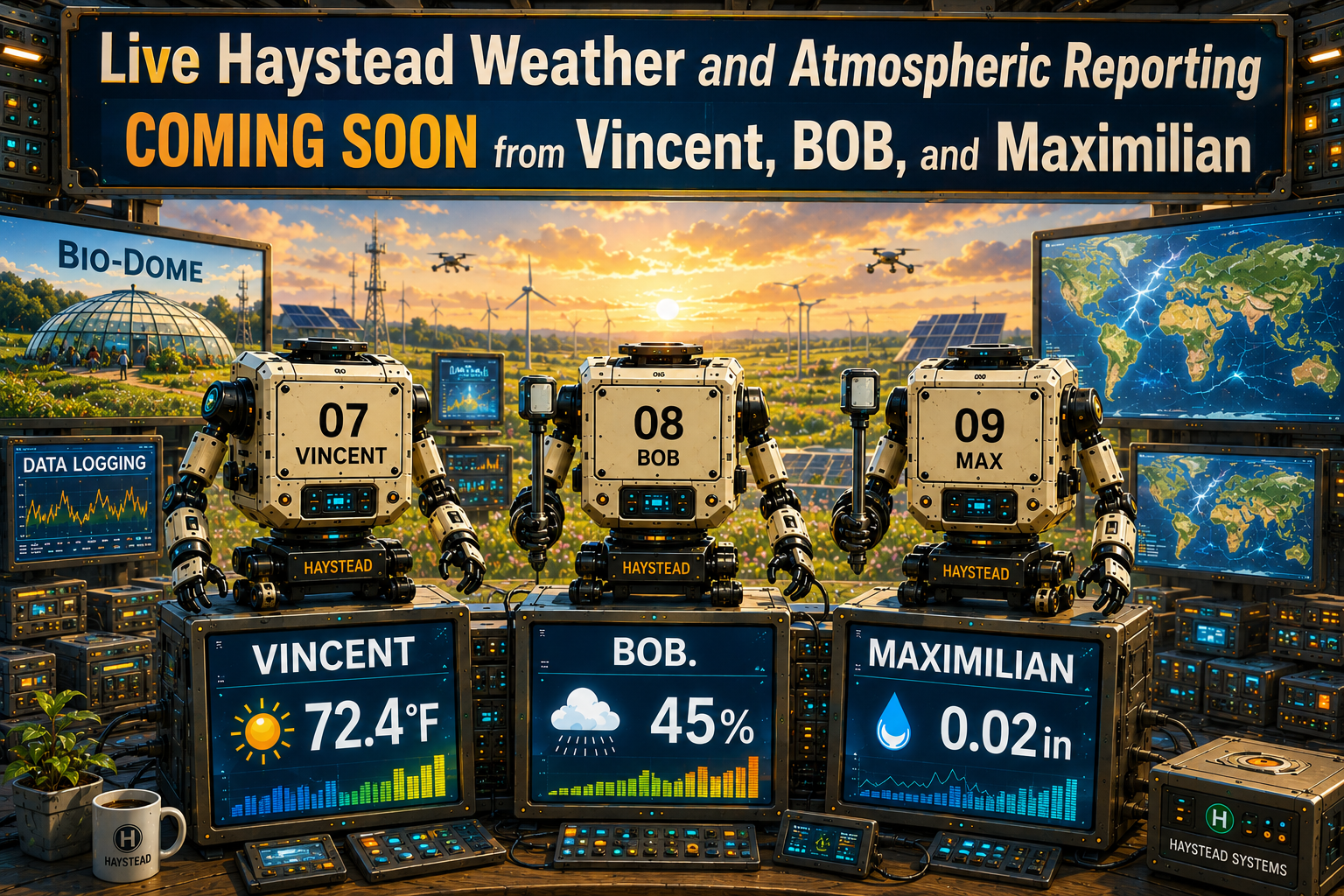
2026 Expedition Season — Project Planning Underway
The 2026 operational season is shaping up to be one of the most active and ambitious years yet at the Haystead Ranch. Planning and preparation are currently in progress across a wide range of initiatives including agricultural development, environmental monitoring, infrastructure expansion, scientific field operations, and collaborative research participation.
From restoring working gardens and expanding renewable systems to advancing atmospheric observation and computational science programs, each project represents a step forward in Haystead’s mission of practical exploration, sustainability, and interdisciplinary discovery.
This page serves as an evolving project log documenting the year’s work as it unfolds. New initiatives, milestones, and field updates will be added throughout the season.
Please check back often — the expedition is just getting started.
HMY-2026-001-AGRO
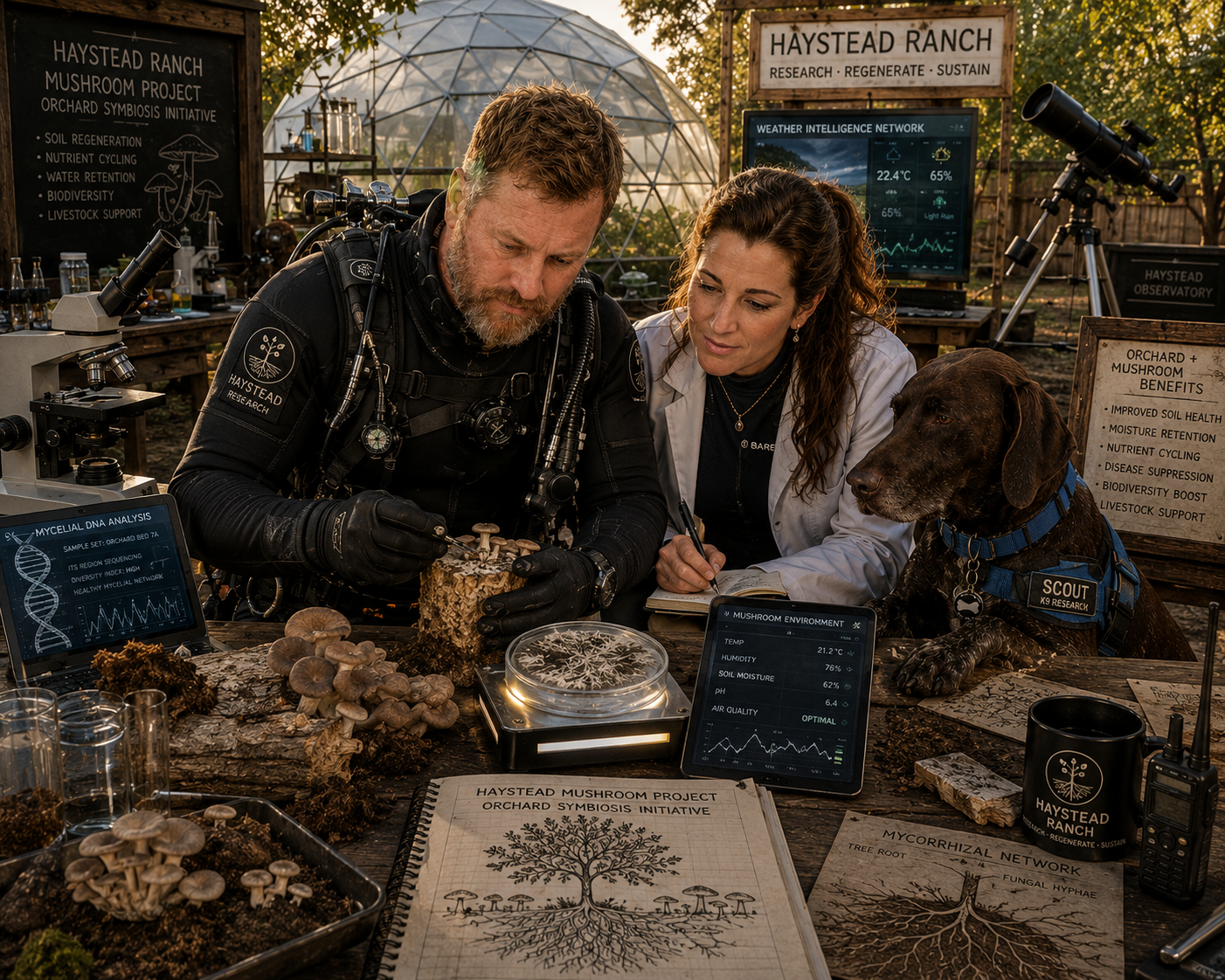
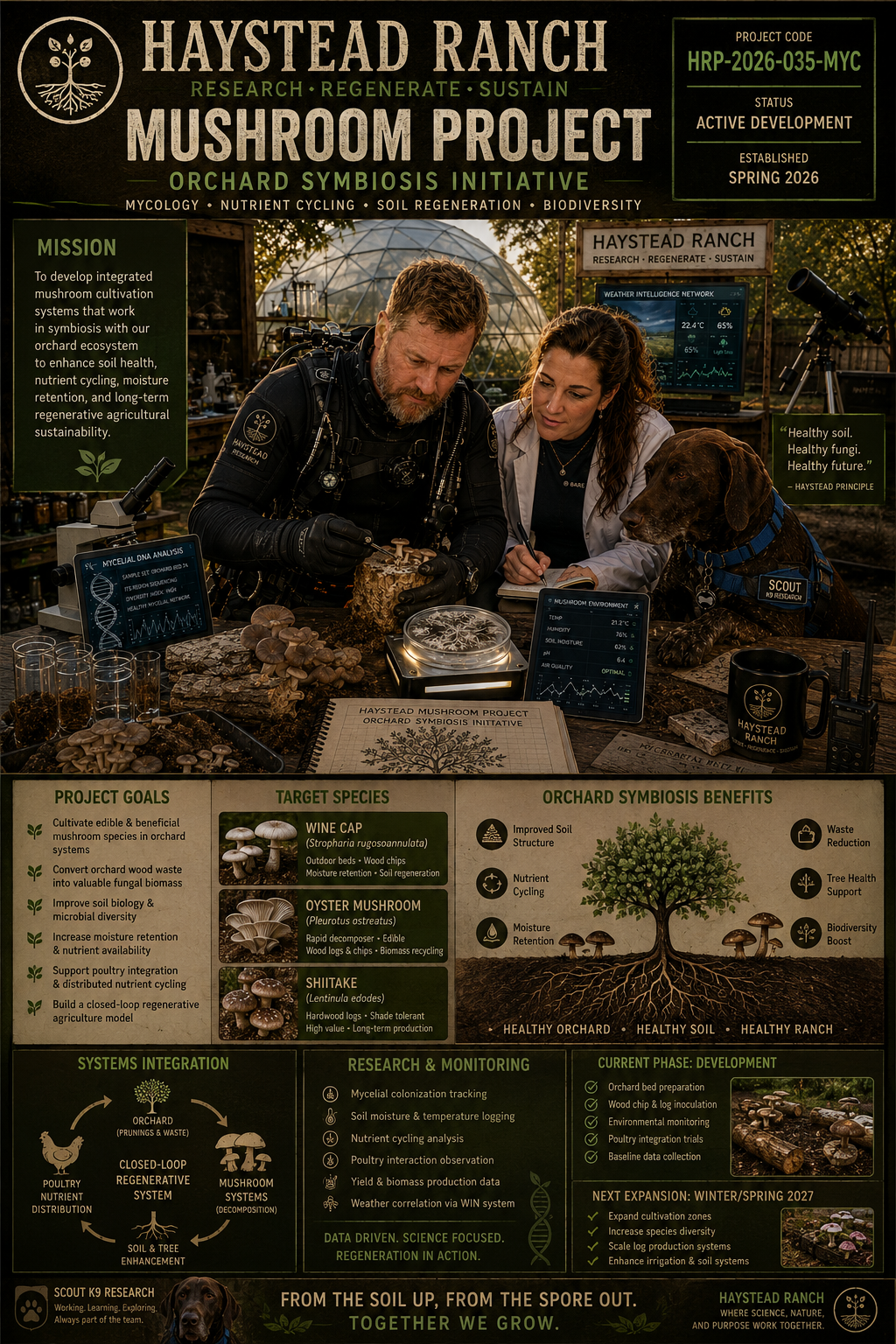
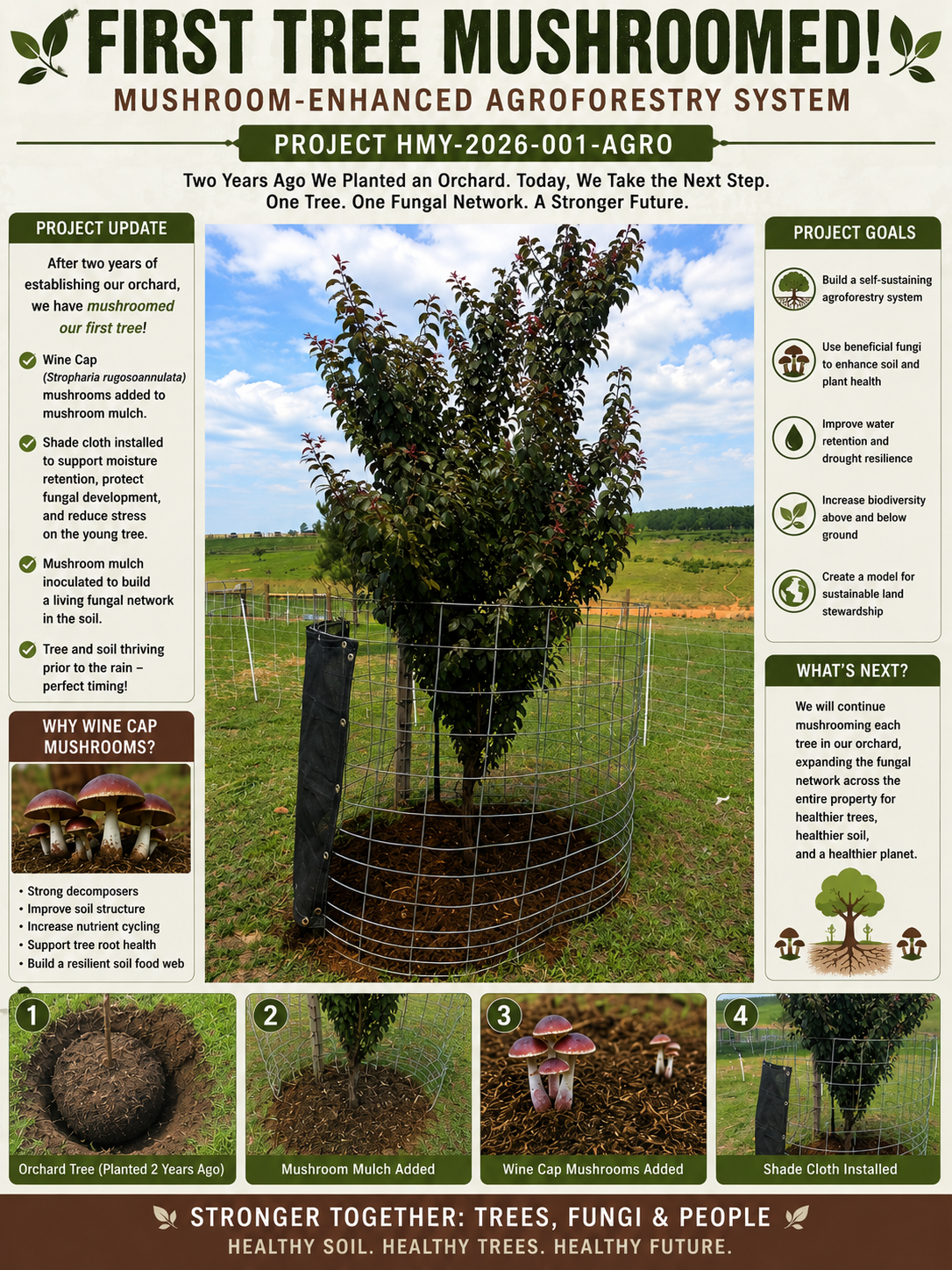
🍄 HMY-2026-001-AGRO
Start Date May 16th 2026
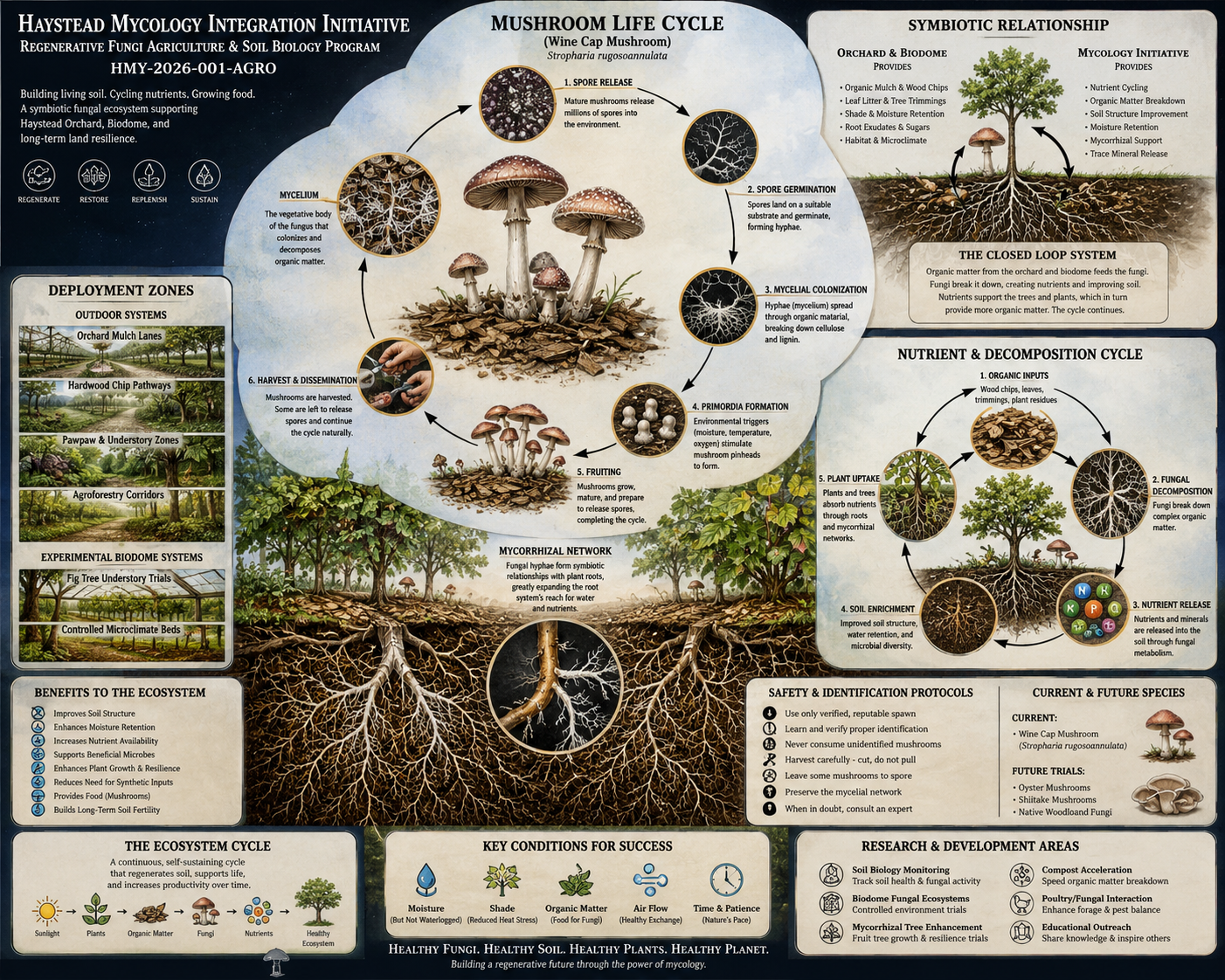
Haystead Mycology Integration Initiative
Regenerative Fungal Agriculture & Soil Biology Program
Project Classification:
Mycology • Regenerative Agriculture • Soil Ecology • Agroforestry Support Systems • Biological Nutrient Cycling
Operational Status:
ACTIVE DEVELOPMENT PHASE
Primary Linked Programs:
🌳 HAG-2026-003-AGRO — Haystead Orchard Development Initiative
🌿 HBD-2026-001-BIO — Haystead Biodome Initiative
Symbiotic Relationship Designation:
The HMY-2026-001-AGRO Initiative operates as an independent but biologically symbiotic support system alongside the Haystead Orchard and Biodome programs. The fungal systems provide nutrient cycling, decomposition, moisture stabilization, and soil enhancement, while the orchard and biodome systems provide organic substrate, mulch resources, shade zones, and ecological habitat support for fungal colonization.
🔬 Project Objective
To establish a scalable regenerative fungal cultivation and soil restoration program utilizing edible mushroom species, fungal-dominated compost systems, and natural decomposition cycles to support sustainable food production and long-term ecosystem resilience throughout Haystead Ranch operations.
🍄 Initial Target Species
Wine Cap Mushrooms (Stropharia rugosoannulata)
Experimental Oyster Mushroom Trials
Future Native Woodland Fungi Research
🌎 Core Operational Goals
Orchard nutrient enhancement
Soil regeneration
Edible mushroom production
Closed-loop organic recycling
Biodome fungal ecology experimentation
Agroforestry ecosystem development
Educational and scientific field research
🛰 Deployment Zones
Primary Outdoor Colonies
Orchard mulch lanes
Hardwood chip pathways
Pawpaw understory zones
Moist shaded agroforestry corridors
Experimental Biodome Colonies
HMY-2026-001B-BIO
Controlled fig-tree understory fungal microclimate trial system.
⚠️ Safety Protocol Classification
Positive species identification required
Verified commercial spawn only
No unidentified wild mushroom consumption
Preservation of fungal networks during harvest operations
📚 Foundational Reference Material
Primary operational inspiration derived from:
“This Might Be The Most AMAZING Intercropping Method Ever!” — MIgardener (2026)
June 15th Update!
HAP-2026-002-AQL
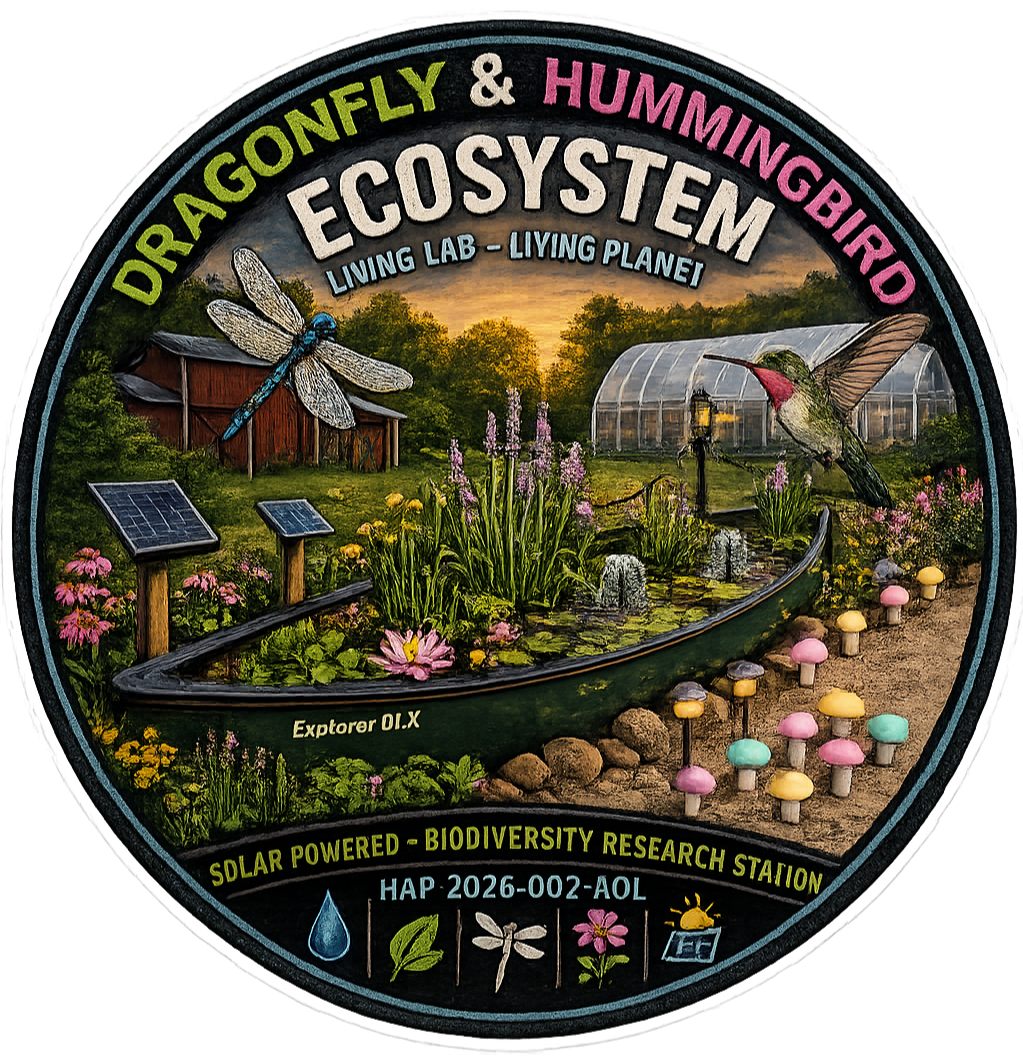
Dragonfly & Hummingbird Ecosystem
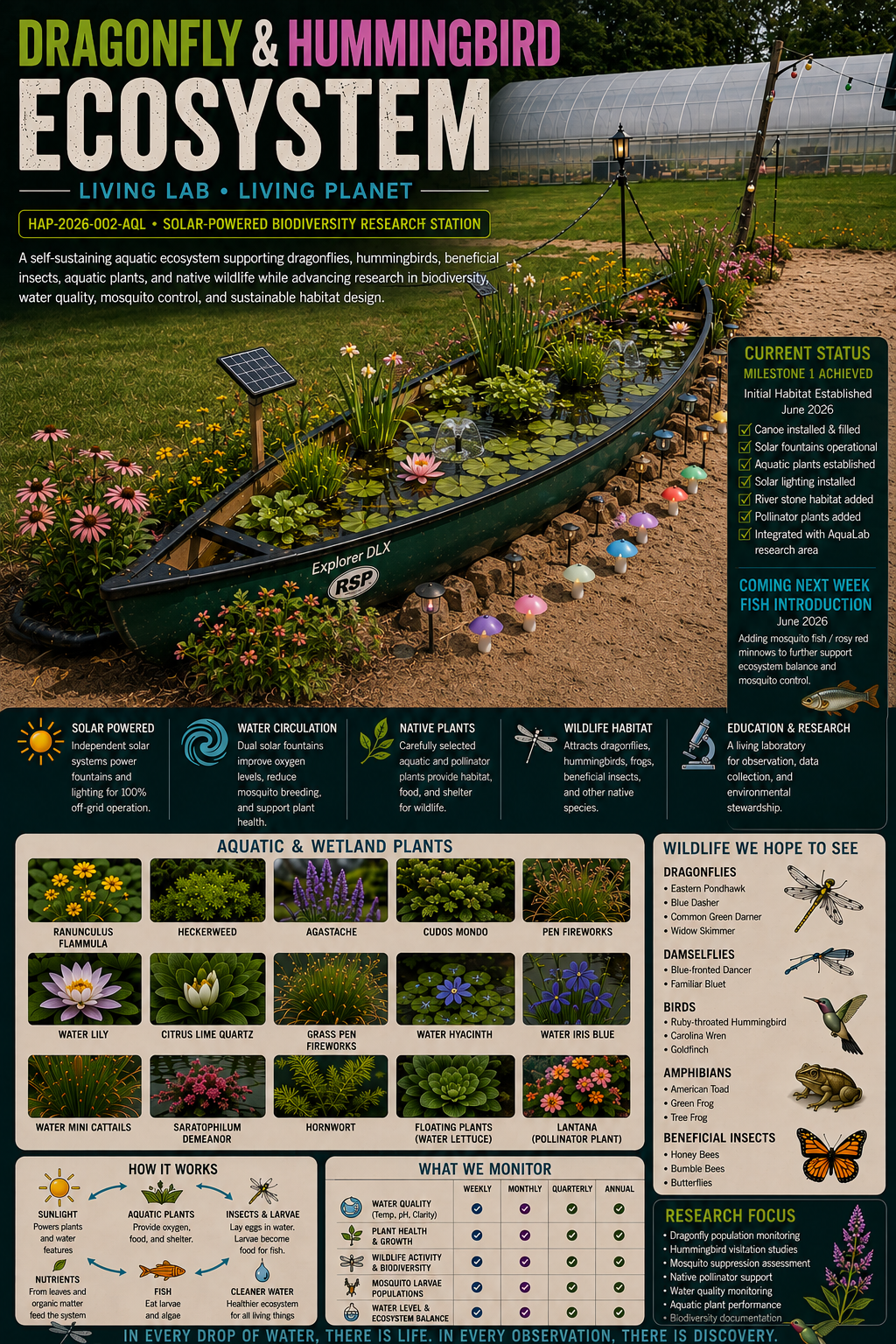
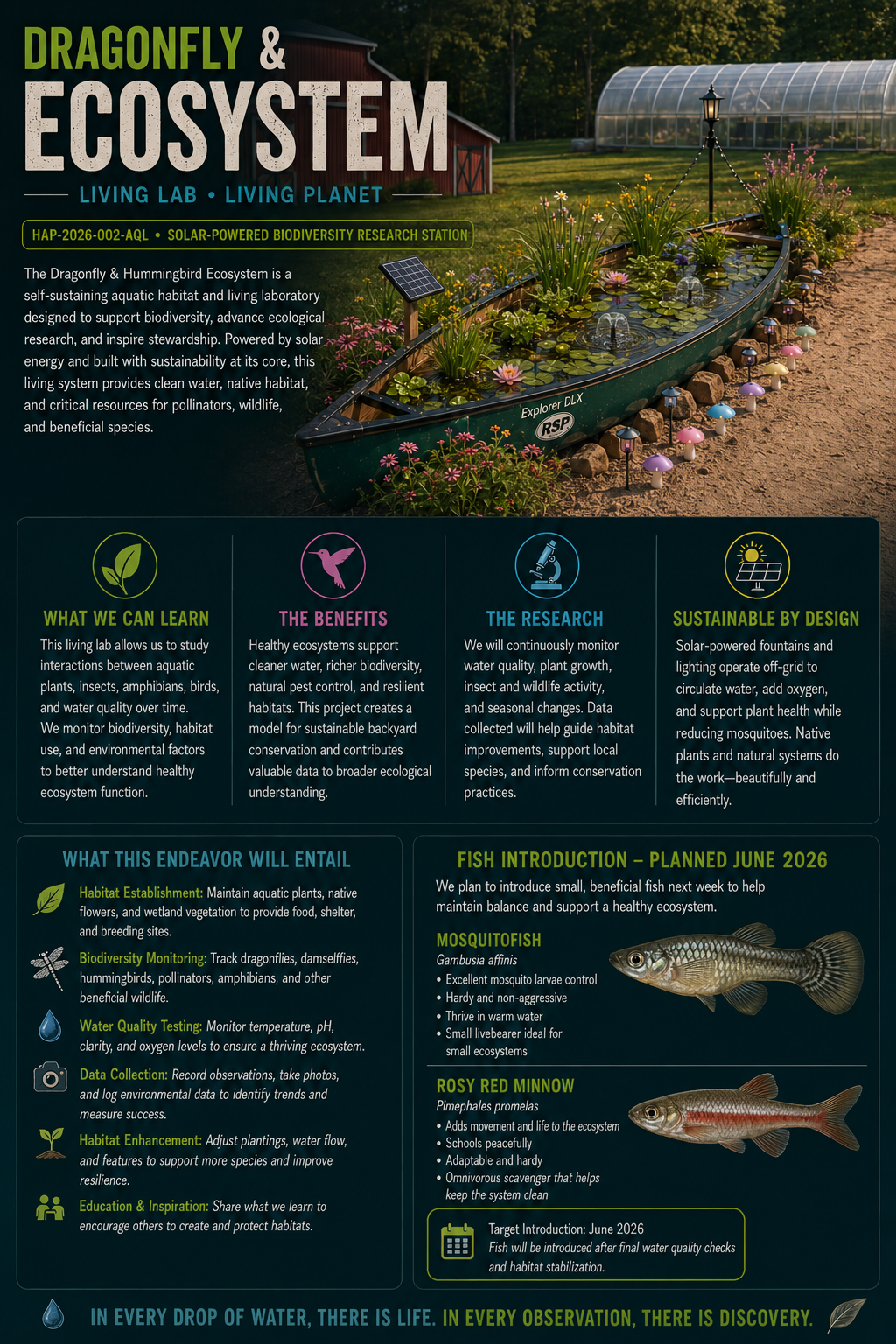
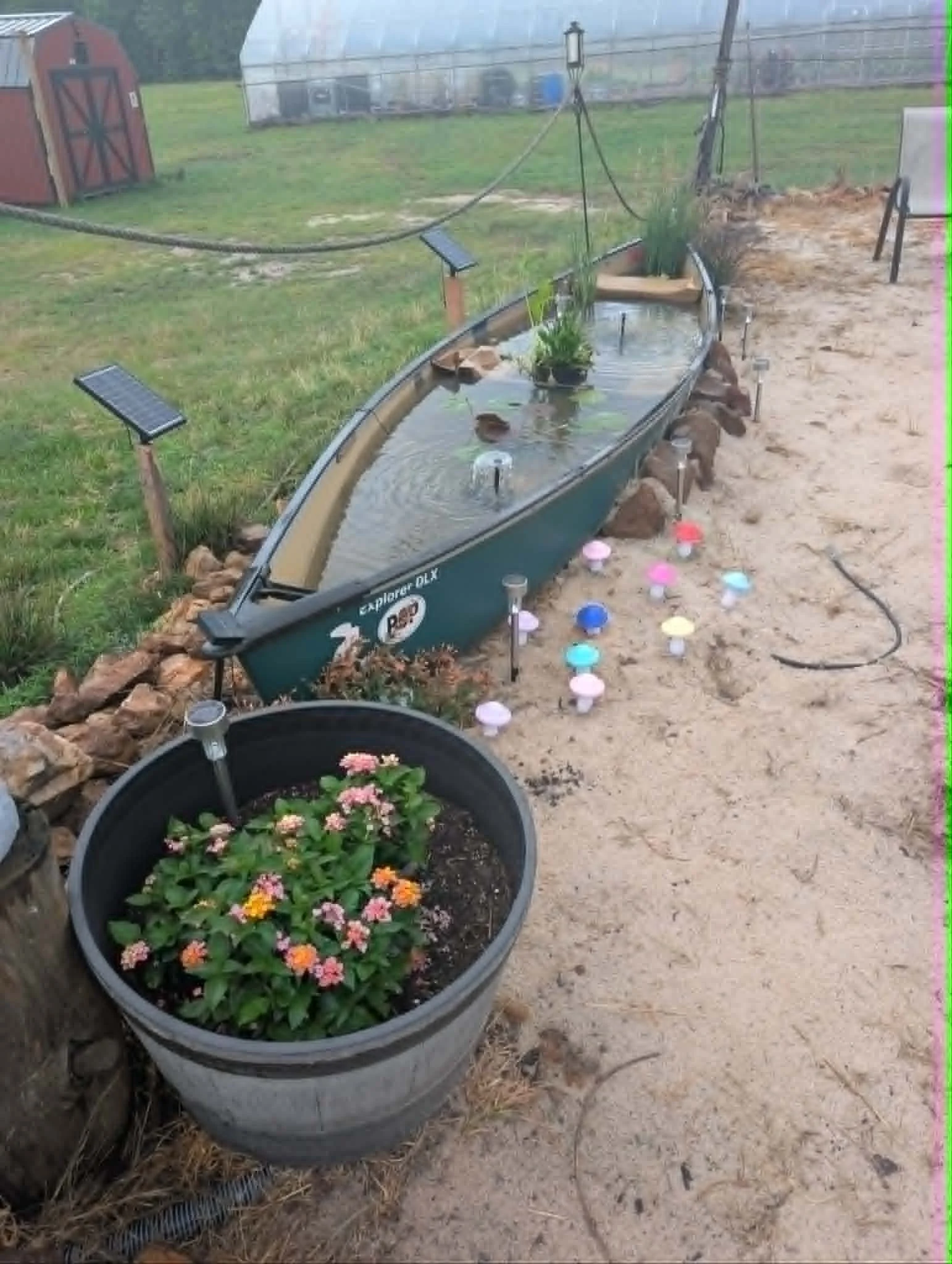
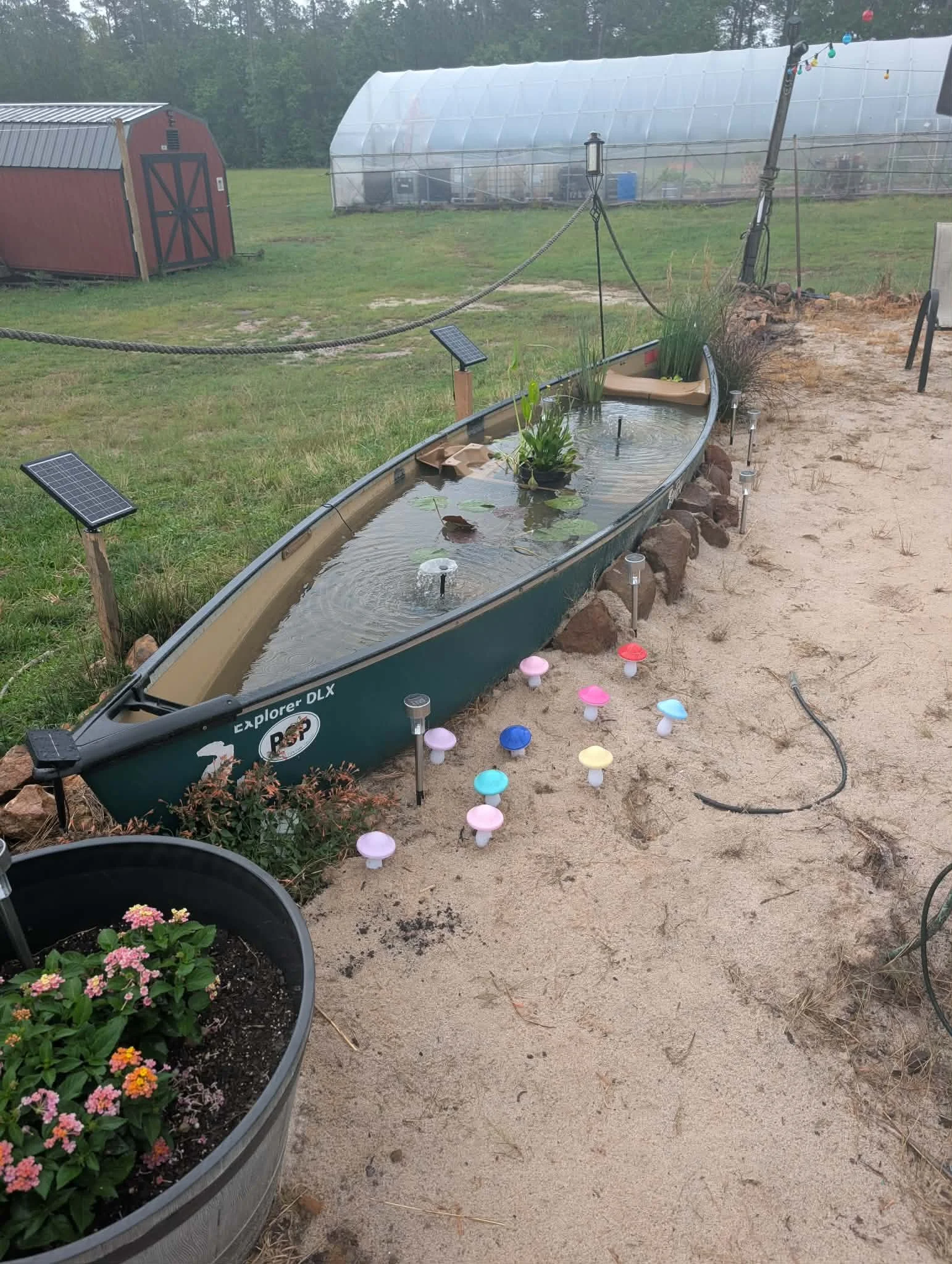
The Dragonfly & Hummingbird Ecosystem is a solar-powered aquatic habitat and living research laboratory located adjacent to the AquaLab at Haystead Ranch. Built within a repurposed Explorer canoe, the project combines aquatic plants, pollinator-friendly vegetation, solar-powered circulation systems, and wildlife habitat features to create a self-sustaining micro-ecosystem.
The primary goal of the project is to explore how small-scale aquatic habitats can support biodiversity while providing practical benefits such as mosquito suppression, pollinator support, water-quality improvement, and wildlife observation. By monitoring plant growth, insect activity, water conditions, and seasonal changes, we hope to better understand the relationships between aquatic ecosystems and the surrounding environment.
This research effort will focus on documenting dragonflies, damselflies, hummingbirds, amphibians, beneficial insects, aquatic plants, and other wildlife that naturally colonize the habitat. Data collected from the project will help guide future habitat designs throughout the Haystead Ranch research areas.
In the coming weeks, we are considering the introduction of small fish species, including Mosquitofish (Gambusia affinis) and Rosy Red Minnows (Pimephales promelas). These species may help control mosquito larvae, contribute to ecosystem balance, and provide additional opportunities to study aquatic food webs within a contained environment.
The Dragonfly & Hummingbird Ecosystem serves as both a scientific research platform and a demonstration project, showing how renewable energy, native habitat creation, and ecological stewardship can work together in a practical and visually engaging way.
HRR-2026-017-ENG: BioDome Power & Infrastructure Initiative
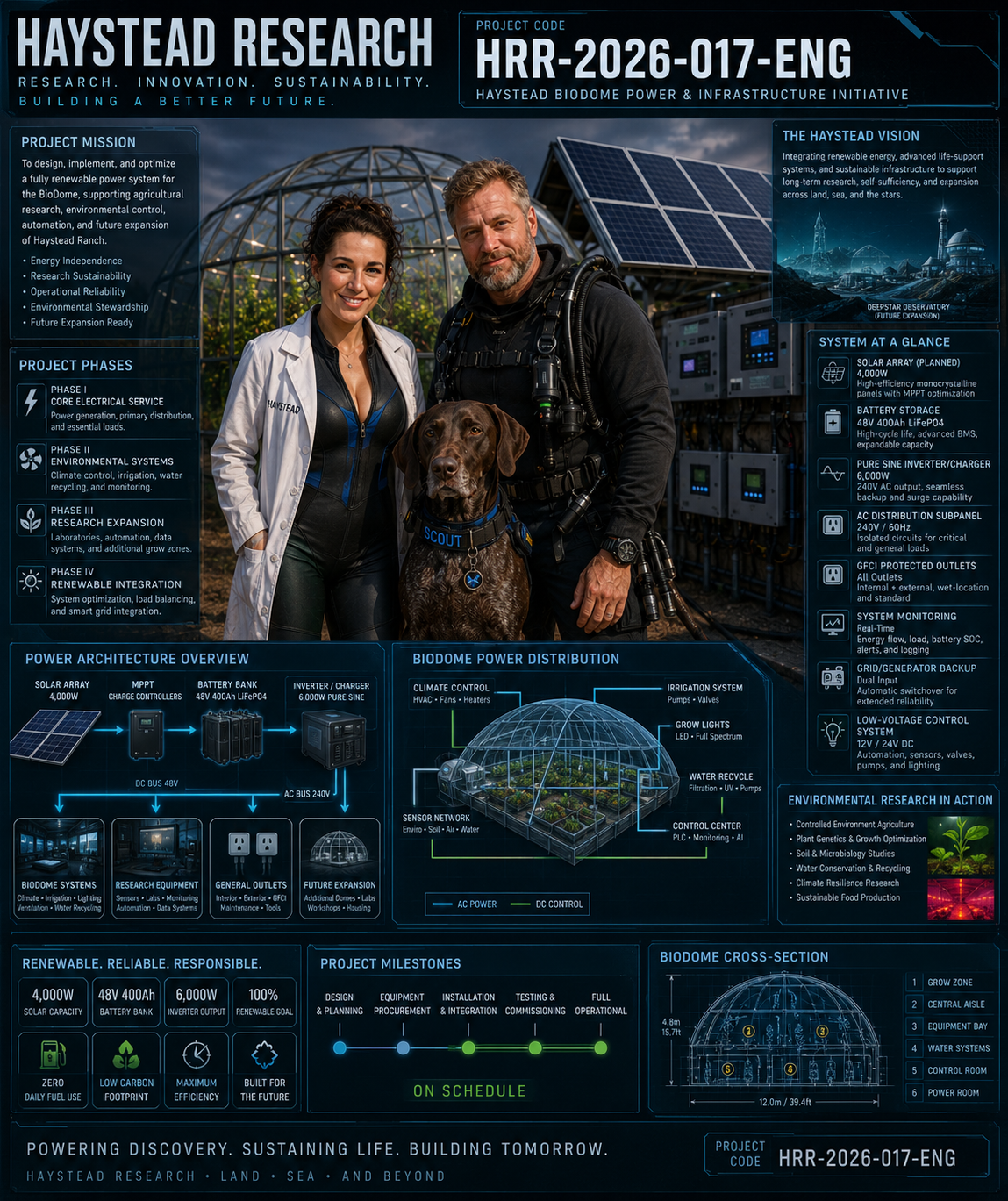
As the Haystead BioLab continues to expand, so do its energy requirements. What began as a modest research facility powered through a connection to the main house has evolved into a complex scientific and agricultural research environment with growing demands for lighting, environmental controls, monitoring systems, communications equipment, water management, and future automation projects.
After careful evaluation, we have determined that the BioLab has reached the point where it must transition from a house-supported system to a dedicated, independent power infrastructure. This need has accelerated the timeline of our planned renewable energy program, moving the project from a future objective to an immediate priority.
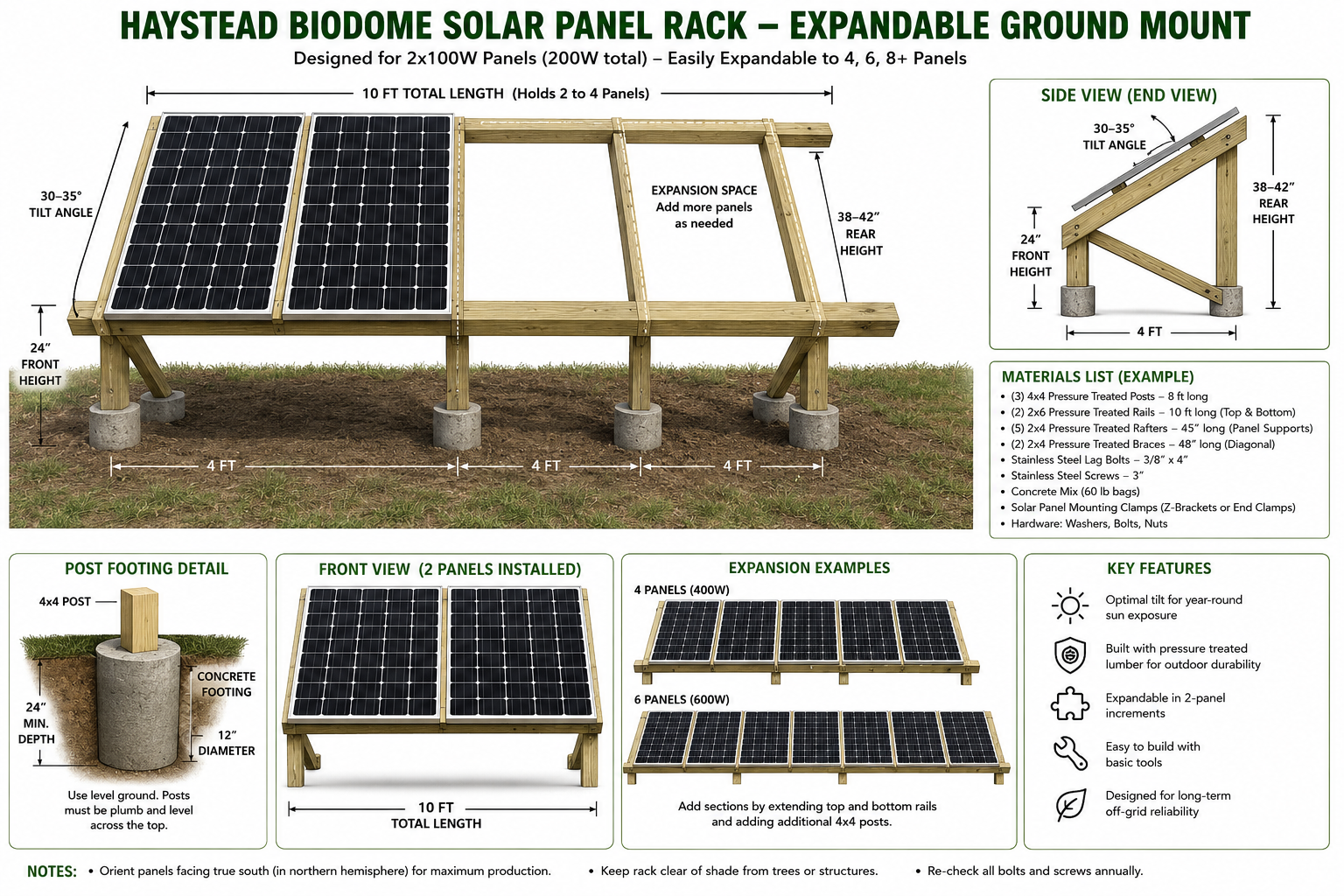
The BioDome Power & Infrastructure Initiative (HRR-2026-017-ENG) will establish a scalable solar-powered energy system designed to support current operations while providing room for future expansion. The project represents a major milestone in the Haystead Ranch mission of creating resilient, sustainable, and self-sufficient research facilities.
By investing in independent energy today, we are building the foundation that will allow the BioLab to continue growing without placing additional demands on household infrastructure, while advancing our long-term goals of sustainability, energy independence, clean agriculture and scientific research excellence.
Project Status: Active - Phase I Construction Beginning Immediately.
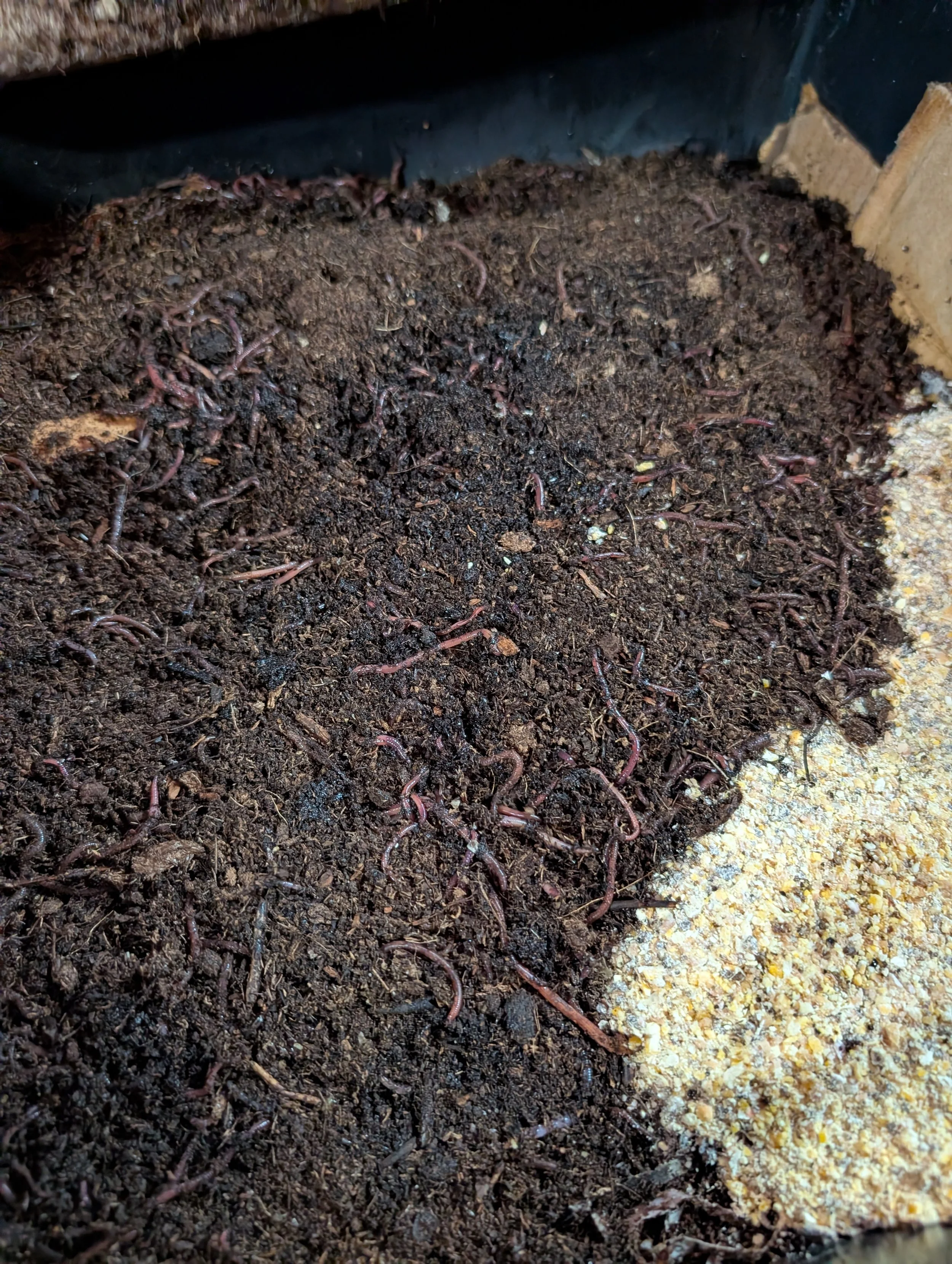
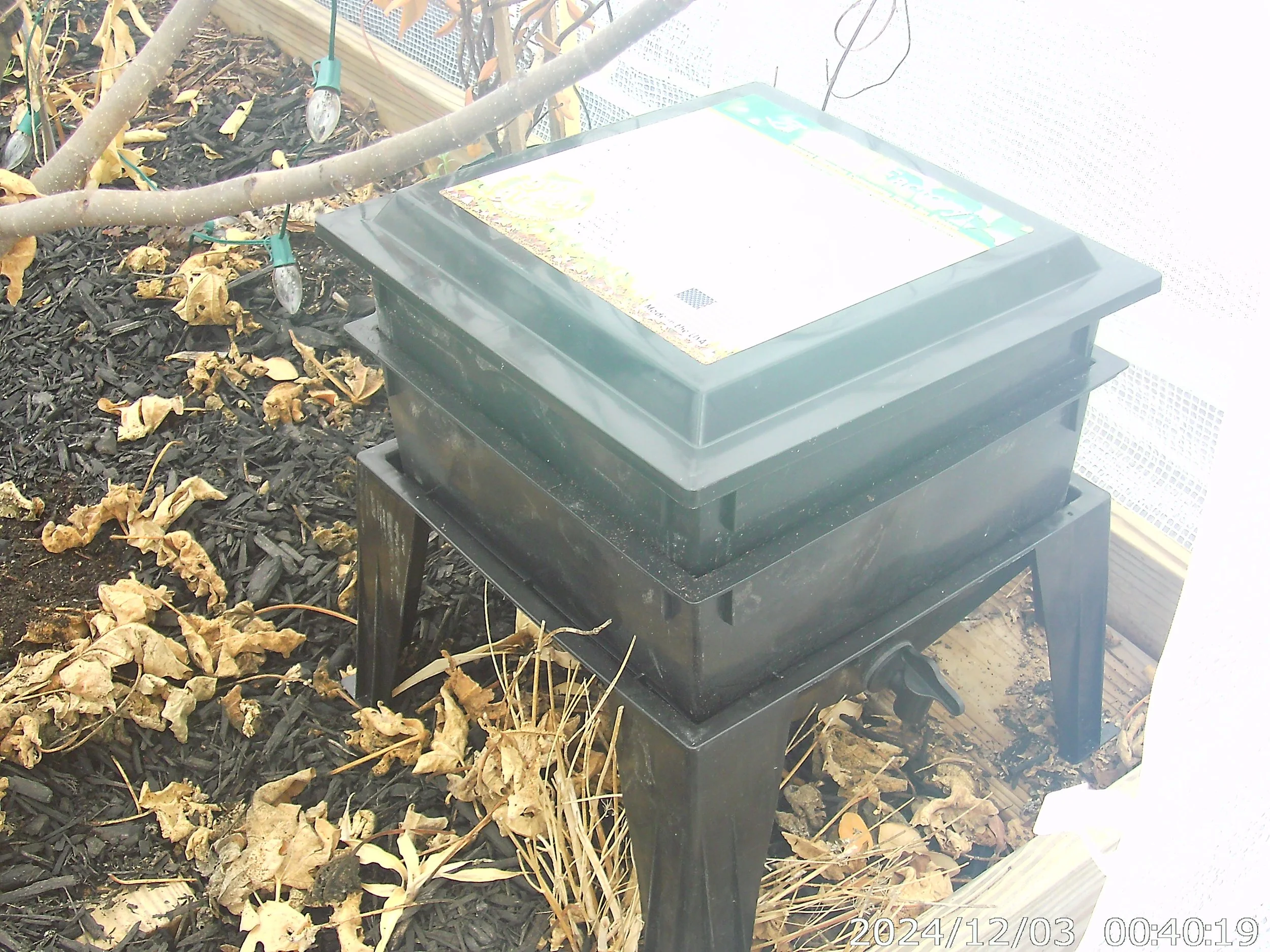
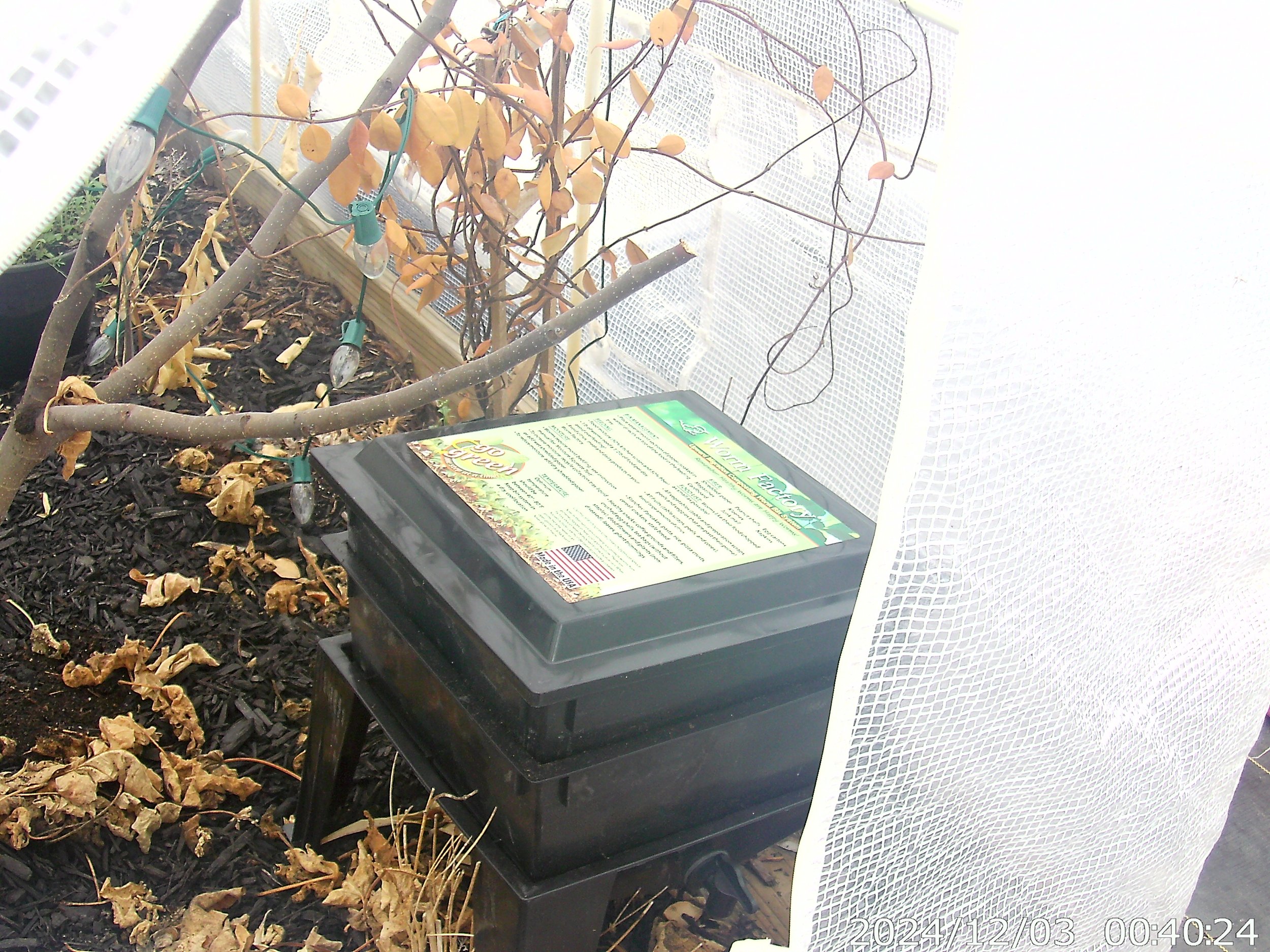
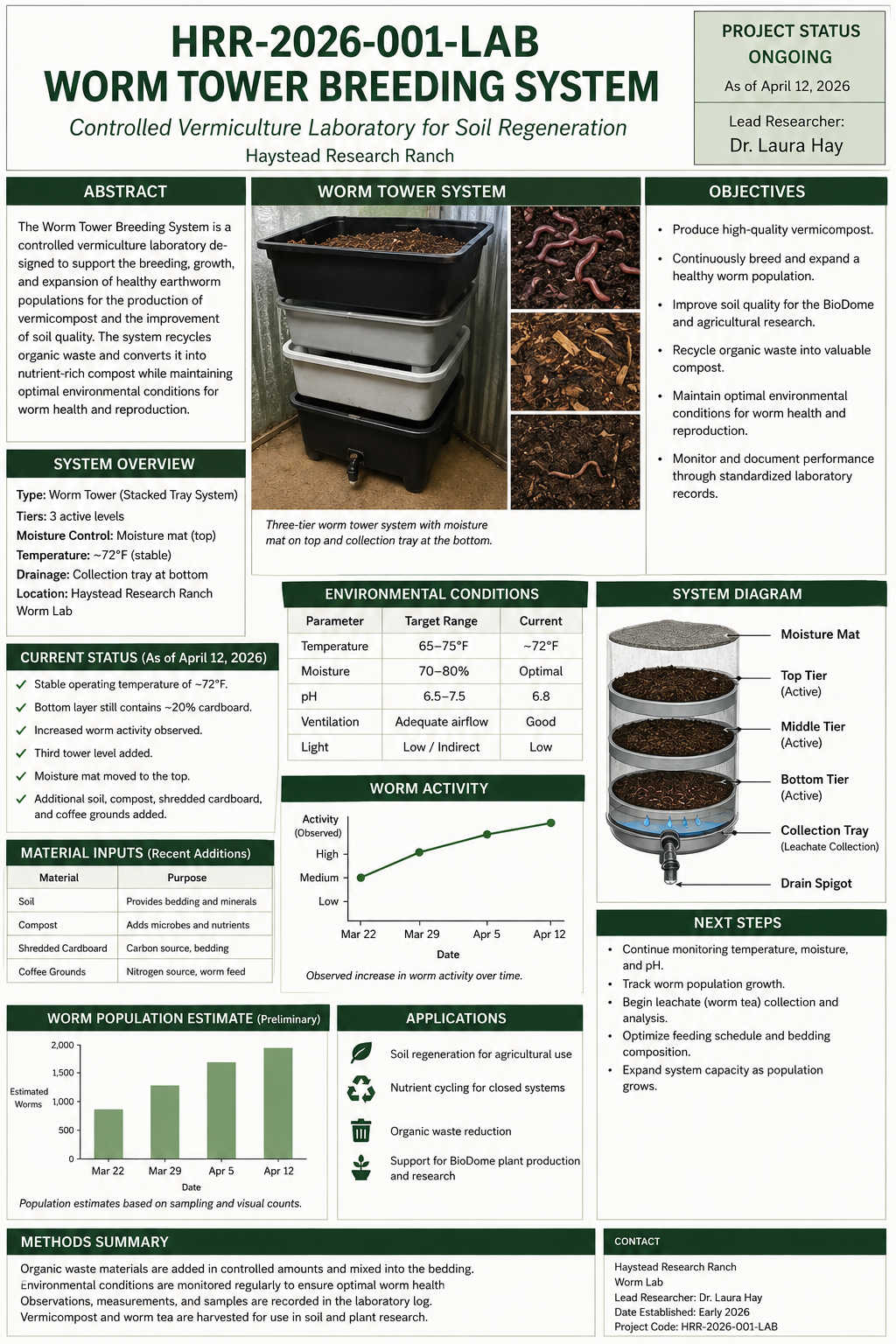
HRR-2026-001-LAB
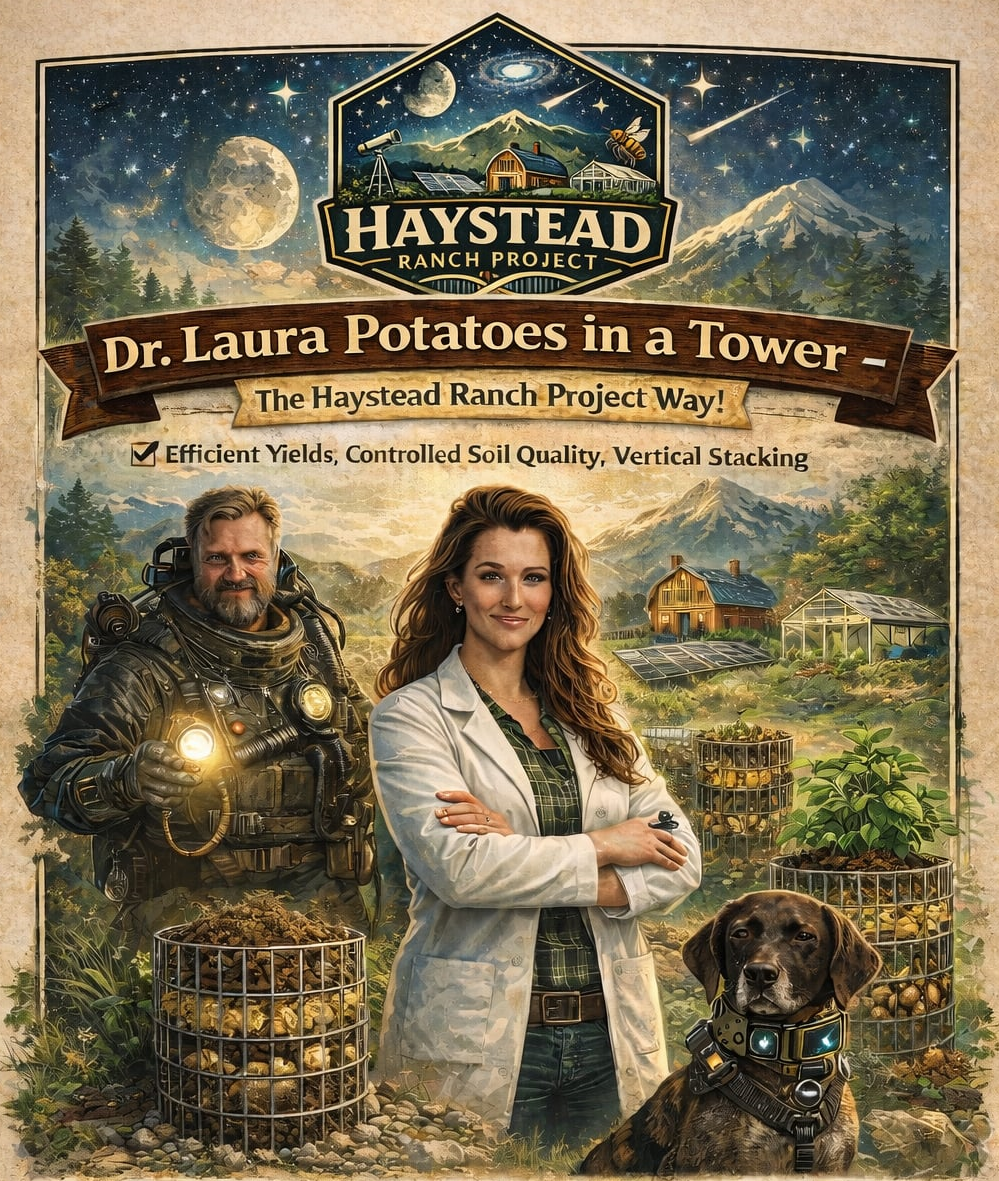
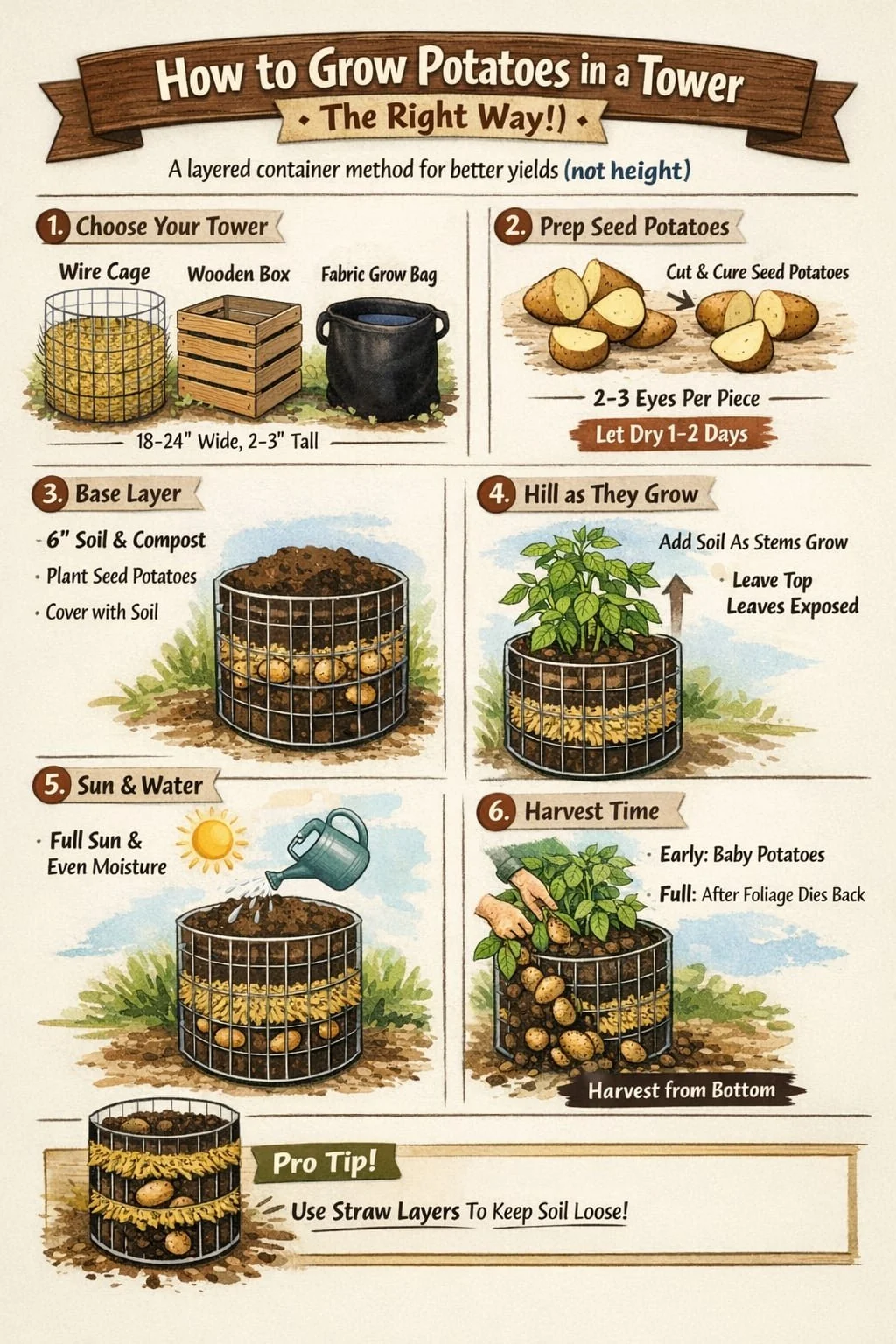
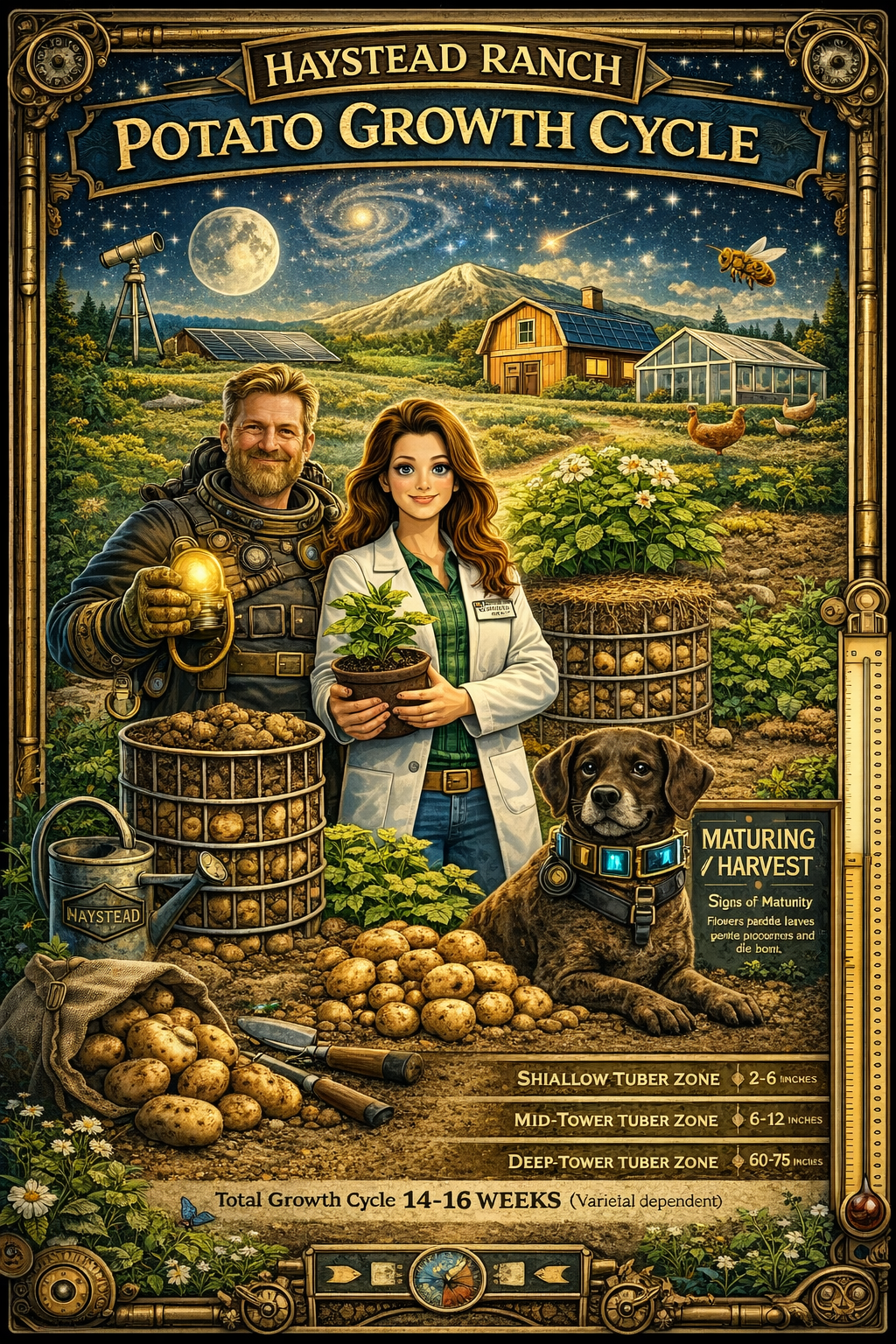
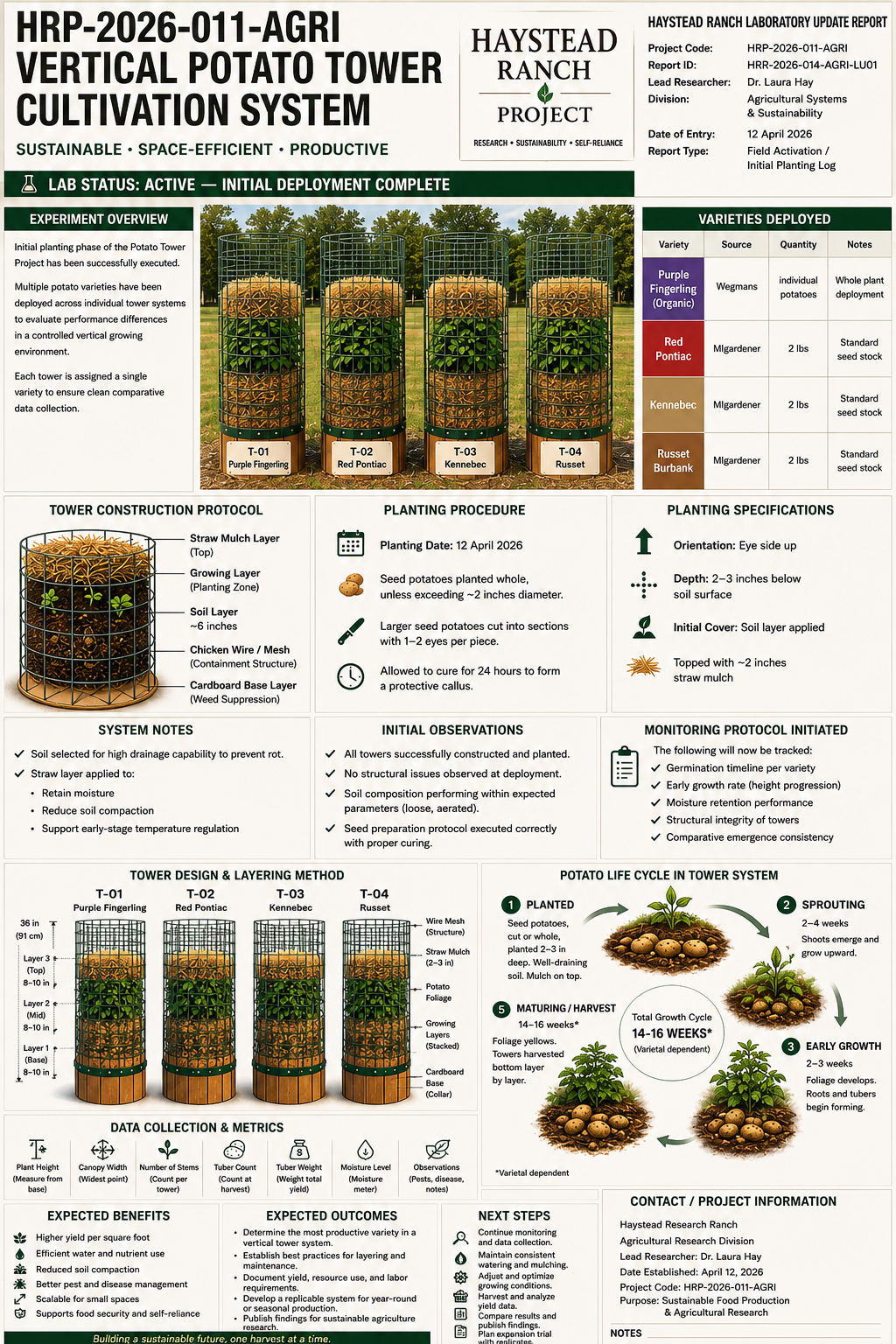
HRP-2026-011-AGRI
HRR-2026-003-HAG
Started March 2026
🌼 HRR-2026-003-HAG
Wildflower Sanctuary Initiative
Pollinator Support & Native Habitat Expansion Program
Project Overview
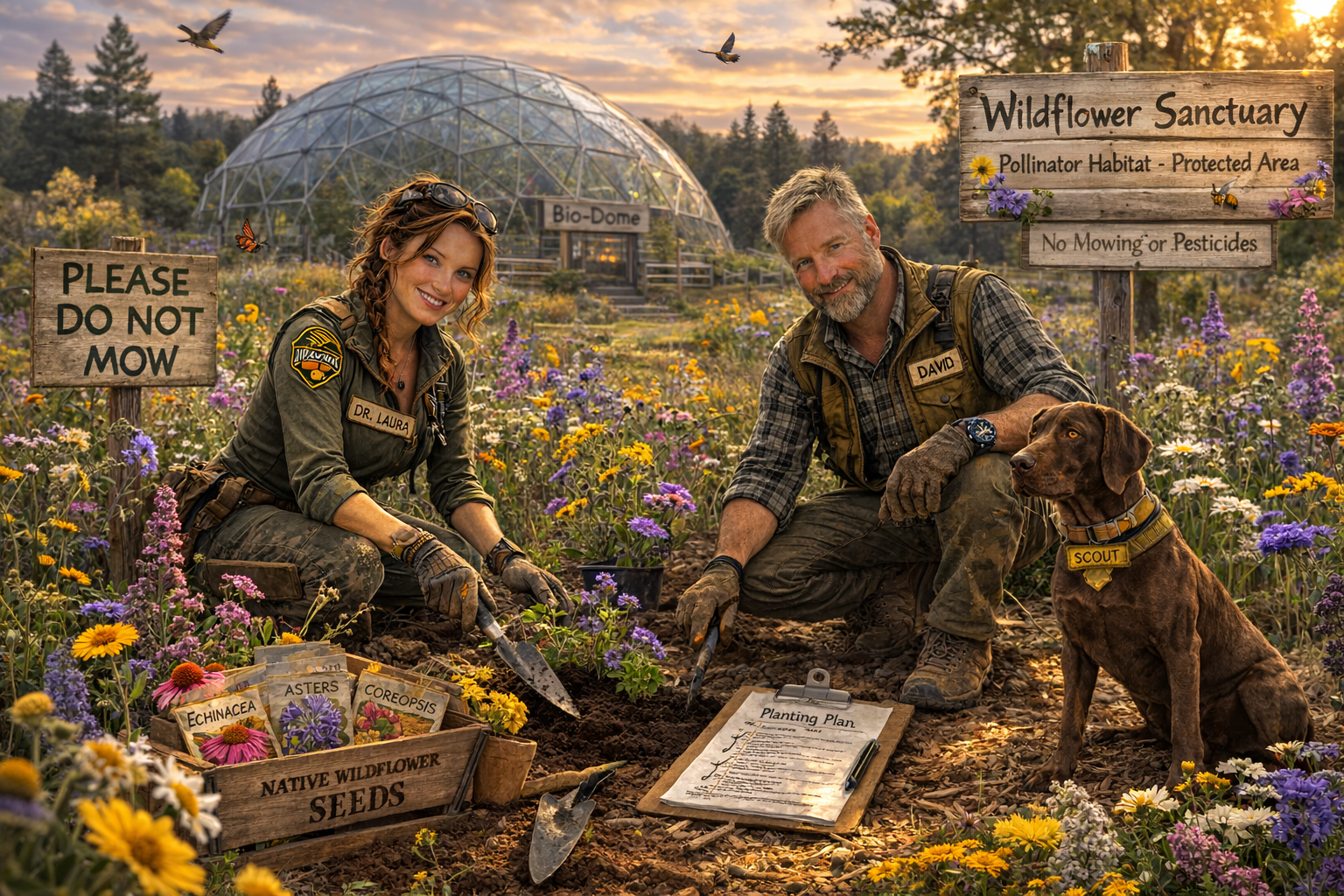
HAG-03 — Wildflower Sanctuary Initiative establishes two dedicated native wildflower plots along the front boundary of Haystead Research Ranch. This project focuses on the encouragement, protection, and expansion of wild and regionally appropriate flowering species to strengthen pollinator populations and enhance ecological resilience.
The sanctuary will serve as both a functional pollinator corridor and a living research platform supporting the upcoming Haybees Project, as well as multiple agricultural and environmental initiatives across Haystead operations.
This effort represents a strategic shift from single-use landscaping toward regenerative, biodiversity-driven land management.
Research & Development Goals
Establish two structured wildflower plots designed for staggered seasonal bloom cycles
Increase native pollinator activity (bees, butterflies, moths, beetles)
Develop habitat zones for protected and beneficial flowering species
Integrate soil health monitoring and microclimate data logging
Support nectar and forage availability for the Haybees Project
Create a replicable sanctuary model for small-scale agricultural properties
Why It Matters
Pollinator populations are foundational to food systems, ecological balance, and long-term agricultural sustainability.
By installing structured wildflower zones at the front of Haystead:
We create visible ecological commitment at the property entrance
We enhance cross-pollination for orchard, herb, and vegetable operations
We strengthen nectar flow availability for future apiary expansion
We improve soil structure through diverse root systems
We reduce erosion and improve water infiltration
The Wildflower Sanctuary directly supports:
🌿 Viking Herb Garden productivity
🐝 Haybees apiary health and honey yield
🌾 Biodome and regenerative agriculture trials
📊 Environmental monitoring and biodiversity tracking
This is not ornamental landscaping — this is ecological infrastructure.
Launch / Operational Plan
Phase 1 — Site Preparation
Soil testing and amendment (organic compost integration)
Removal of invasive grasses
Light till or no-till seed bed preparation depending on soil condition
Boundary marking and irrigation planning
Phase 2 — Species Selection & Seeding
Native perennial wildflowers
Pollinator-dense annuals for first-season establishment
Protected and regionally significant flowering species
Staggered bloom schedule design (early spring → late fall coverage)
Phase 3 — Monitoring & Data Collection
Pollinator activity counts
Bloom cycle documentation
Soil moisture and nutrient tracking
Cross-reference with Haybees hive productivity once activated
Support & Participation Opportunities
Seed sponsorship program (native species adoption)
Volunteer planting day (seasonal activation event)
Citizen science pollinator observation logs
Educational signage for ecological awareness
Collaboration with local conservation groups
The sanctuary will also serve as a demonstration model for regenerative landscaping practices in small agricultural settings.
Mission Objective
To establish a resilient, data-informed wildflower sanctuary that strengthens pollinator populations, enhances biodiversity, and supports Haystead’s integrated agricultural ecosystem — while laying the ecological groundwork for the Haybees Project.
This initiative transforms the entrance of Haystead into a living statement of purpose:
Protection. Regeneration. Interdependence.
Build / Implementation Guide
Materials Needed:
Native wildflower seed mix (regionally appropriate)
Compost / organic soil amendment
Mulch (straw or leaf cover for erosion control)
Irrigation lines or drip system (if required)
Soil testing kit
Pollinator observation log sheets
Basic Installation Steps:
Conduct soil test and adjust pH if required
Remove invasive vegetation and debris
Lightly rake or prepare seed bed
Broadcast seed mix evenly
Gently press seed into soil (do not bury deeply)
Apply light mulch cover
Water lightly and consistently during germination period
Monitor bloom cycles and pollinator activity
Ongoing Maintenance:
Minimal mowing (season-end only)
Controlled reseeding for density management
Invasive species removal
Annual soil health reassessment
🌼 HAG-03 Status: Activation Pending
Wildflower Sanctuary Installation — Front Perimeter Zones A & B
🌼 HRR-2026-003-HAG
Wildflower Sanctuary Initiative
Lab Update Report — 418
Barrier 1 Activation Log
🔬 Experiment Status
Phase: Initial Field Deployment
Zone: Barrier 1 (Front Perimeter Test Section)
Date: April 18, 2026
Status: ✅ Planting Complete — Germination Phase Pending
🌱 Site Conditions
Soil Type: Clay-dominant native soil
Amendments: None
Invasive Removal: None
Preparation Method: Minimal disturbance (scratch-in / rake-to-native soil)
🌼 Planting Execution
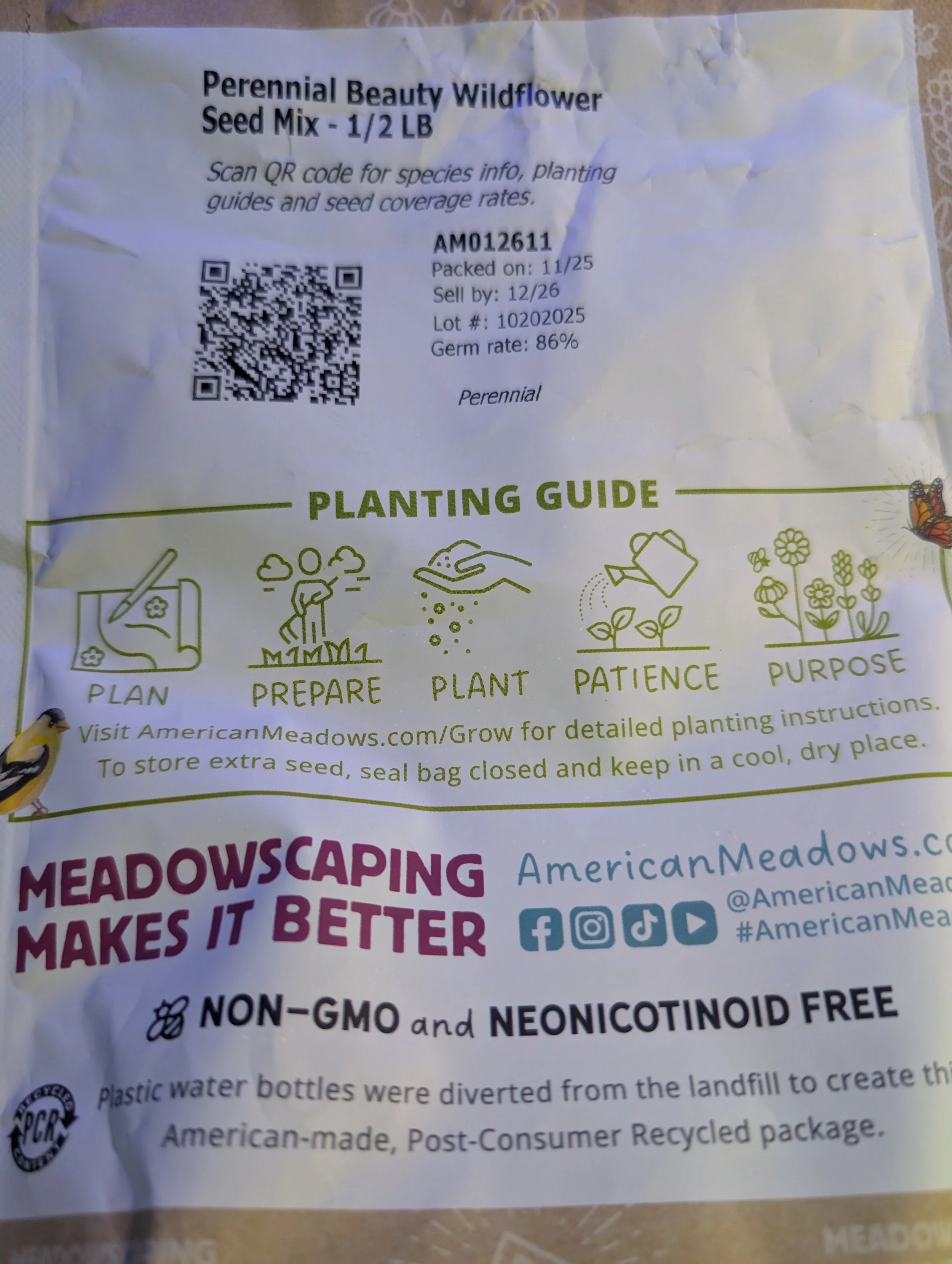
Plot Group A — Perennial Mix
Seed Type: Perennial Beauty Wildflower Mix
Classification: Perennial
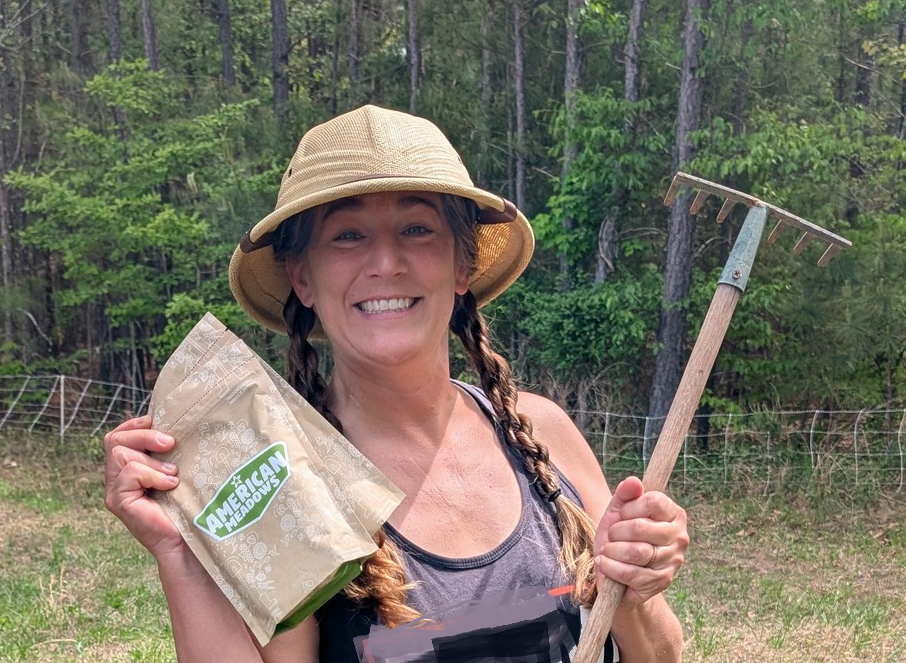
Source: American Meadows
Method: Scratch-in (rake integration into native soil)
Coverage: 4 small test plots
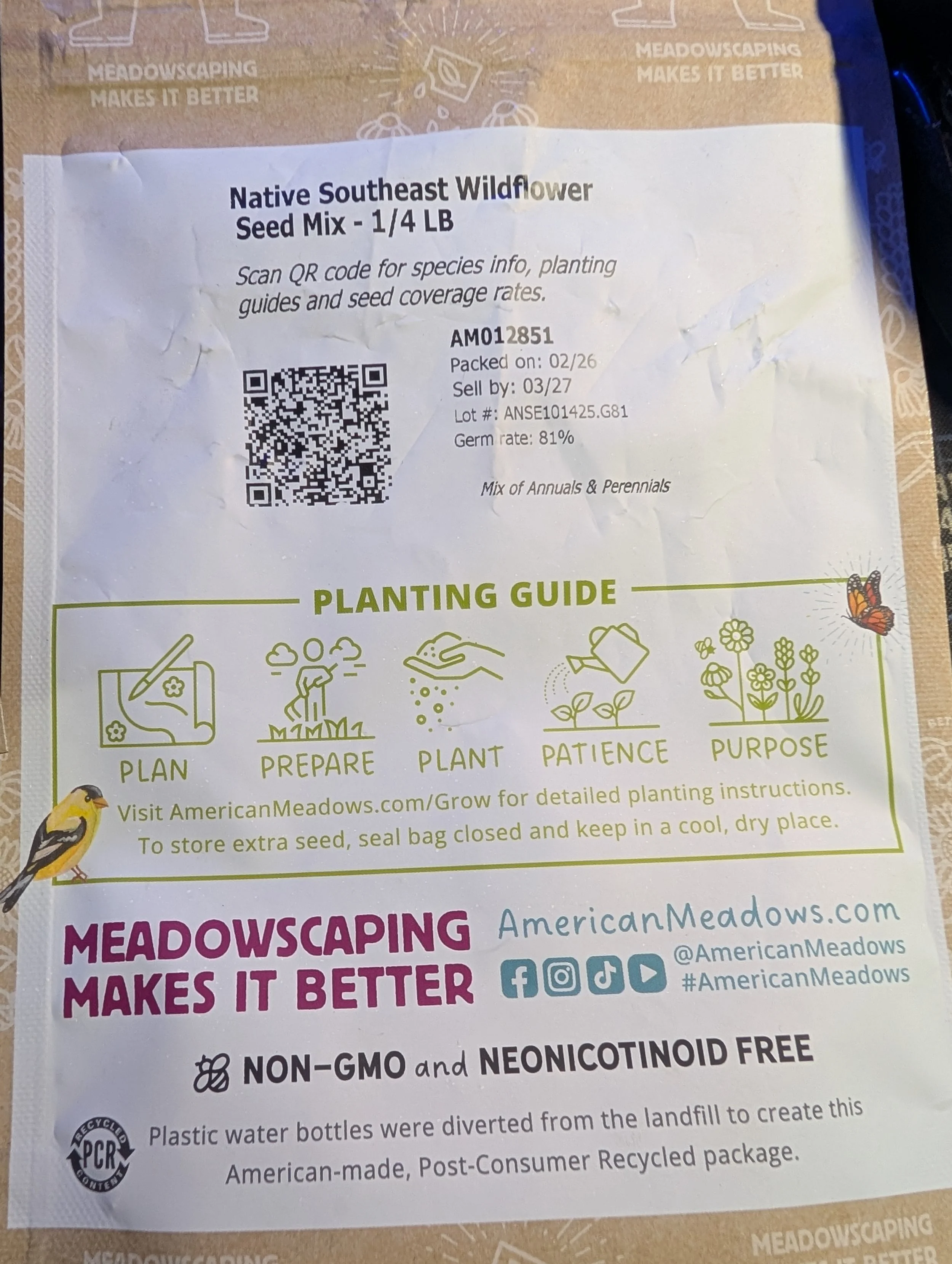
Plot Group B — Native Regional Mix
Seed Type: Native Southeast Wildflower Mix
Classification: Annual + Perennial Blend
Source: American Meadows
Method: Scratch-in (rake integration into native soil)
Coverage: 4 small test plots
🌡️ Environmental Conditions at Time of Planting
Time: 12:00 (Midday)
Temperature: 85°F
Weather: Sunny, clear conditions
🐝 Pollinator Activity Observed
Butterflies
Moths
Beetles
Observation Note:
Active pollinator presence prior to establishment suggests favorable habitat potential and validates site selection.
🌧️ Operational Strategy Note
Planting timing was intentionally aligned with forecasted light rainfall (within ~24 hours) to:
Initiate natural seed-to-soil contact hydration
Reduce need for artificial irrigation
Improve early-stage germination success
Initial observation indicates adequate soil moisture activation following planting window.
📊 Field Interpretation (Preliminary)
Scratch-in method successfully deployed in clay soil without amendment
Dual-mix strategy (perennial vs. native blend) establishes comparative growth study potential
Immediate pollinator presence supports viability of location as a future corridor
Rain-assisted germination expected to improve early establishment rates
🔁 Next Monitoring Objectives
Germination emergence tracking (Days 5–14)
Soil moisture retention assessment (post-rainfall)
Early species differentiation logging
Pollinator return frequency baseline
📸 Field Documentation
Seed source packaging and QR references recorded
Visual documentation to be attached to project archive and web publication
🧭 Status Summary
Barrier 1 successfully transitioned from planning → active ecological deployment.
This marks the first live installation of the Wildflower Sanctuary system and establishes the baseline for all future zones.
HRR-2026-003-HAG – Wildflower Initiative Status Update
The initial phase of the Wildflower Initiative has unfortunately not met its intended objectives. Despite site preparation and planting efforts, the overwhelming majority of the wildflower seed failed to establish. Current observations suggest that a combination of prolonged heat, insufficient rainfall, and challenging growing conditions significantly reduced germination and survival rates. While disappointing, this outcome provides valuable field data that will help guide future restoration efforts.
The project is not being abandoned. Instead, it is being classified as a temporary setback, and the Haystead Research Ranch team is already evaluating improvements for the next planting cycle. Planned corrective actions include enhanced soil preparation, increased fertilization, and a complete replanting during the more favorable spring growing season. As with all Haystead research initiatives, documenting both successes and failures is an essential part of refining sustainable land management practices.
HRP-2026-021-WP
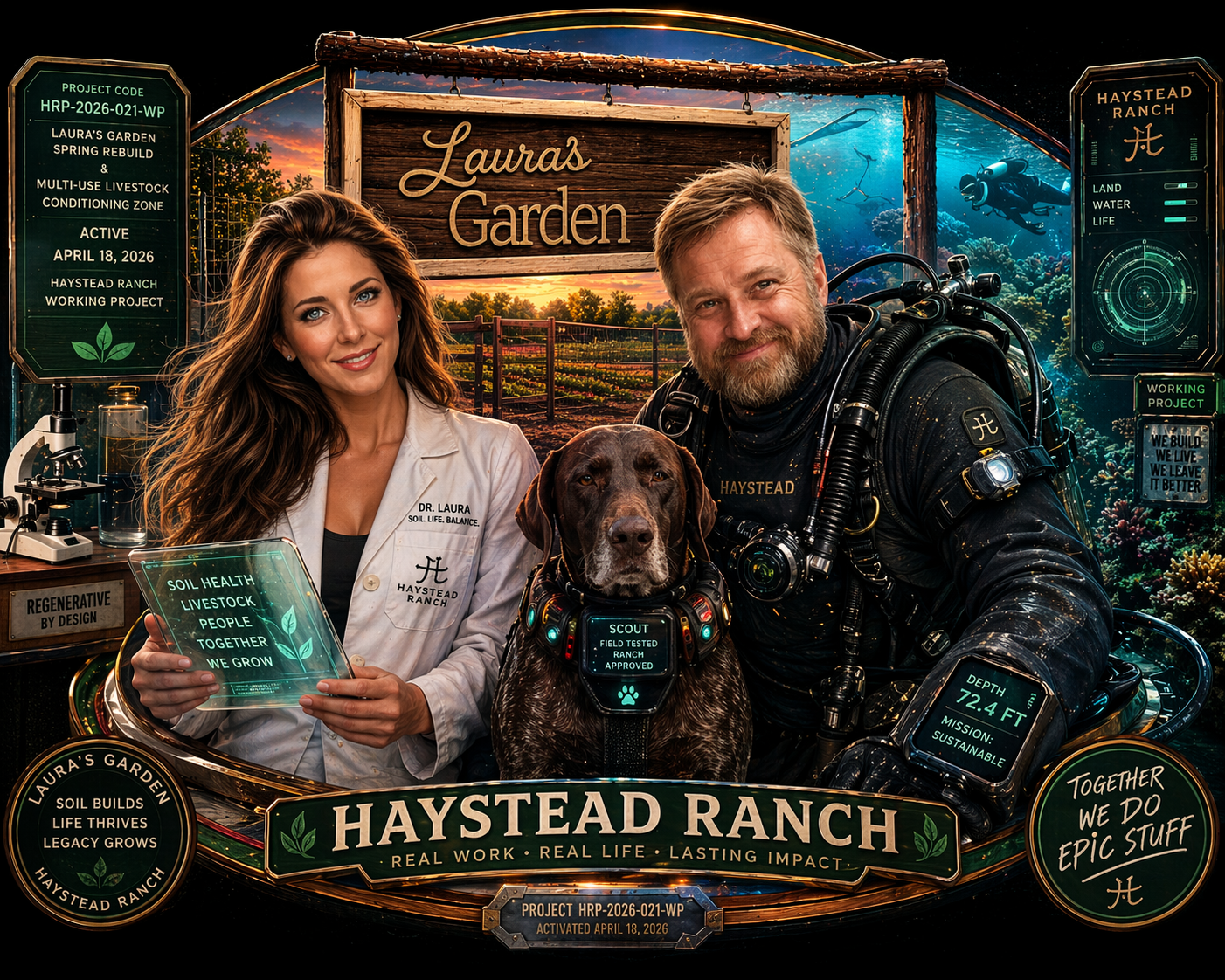
🌱 HAYSTEAD RANCH WORKING PROJECT ACTIVATION New 4/18/2026
Project Code: HRP-2026-021-WP
(Haystead Ranch Project — Year 2026 — Project #021 — Working Project)
🧭 Project Title
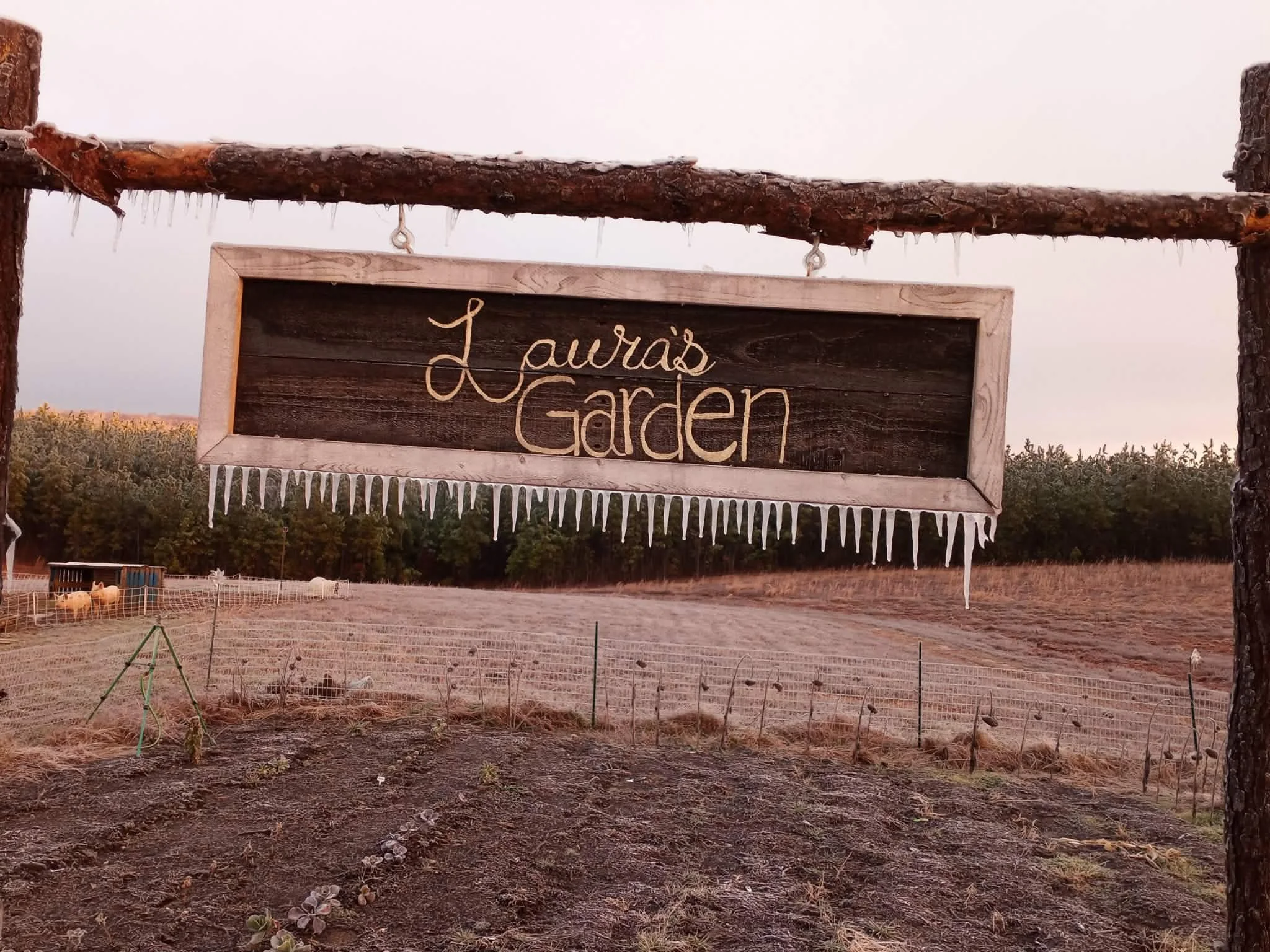
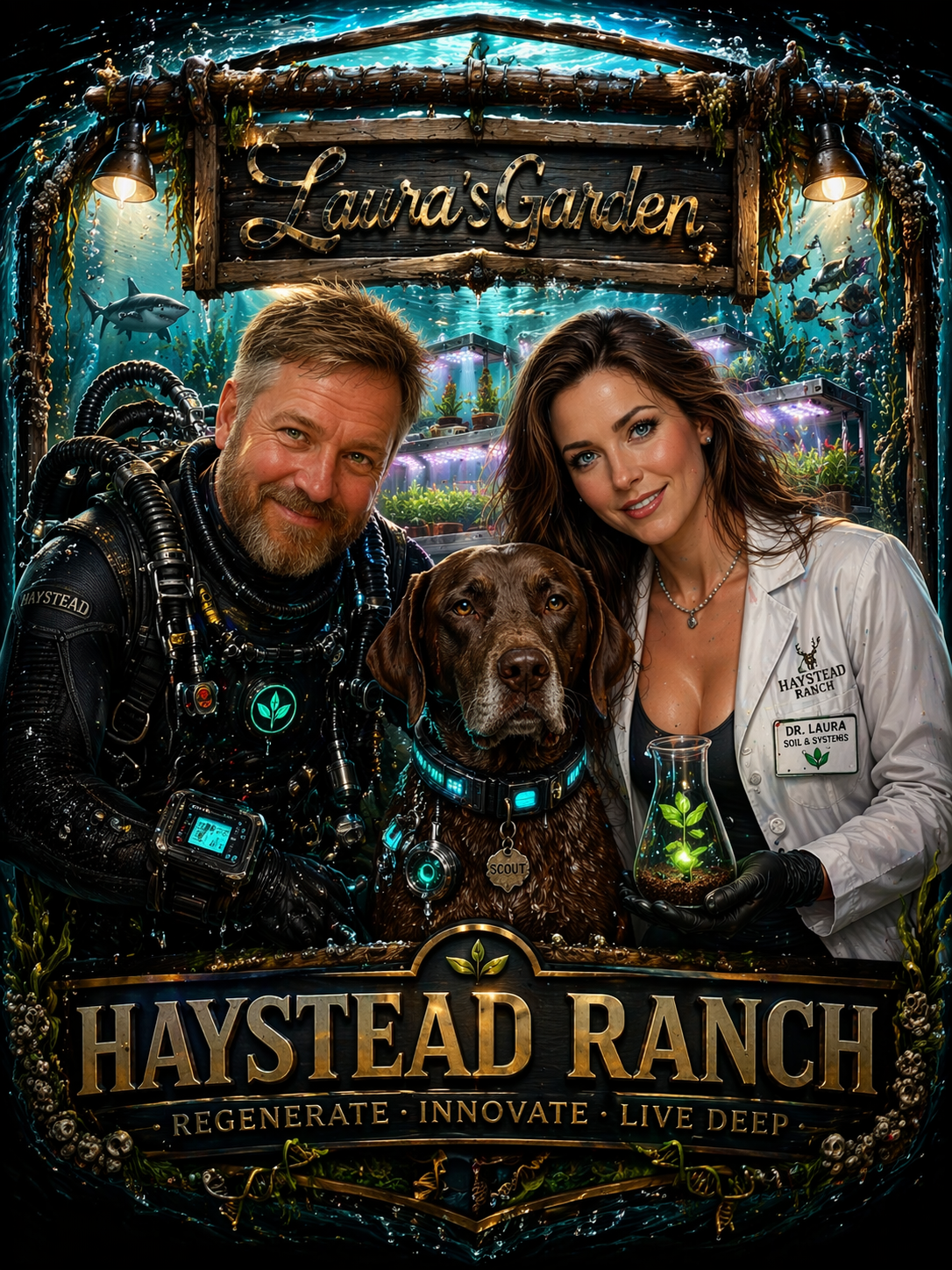
Laura’s Garden Spring Rebuild & Multi-Use Livestock Conditioning Zone
📍 Project Location
Haystead Ranch — “Laura’s Garden” Enclosure
Size: ~50 ft x 50 ft
Type: Fenced, high-fertility soil zone
Current Use: Hybrid garden + juvenile livestock protection area
🧪 Project Classification
Working Project (Operational / Agricultural Infrastructure)
Non-experimental — applied land management and livestock support system
📅 Activation Date
April 18, 2026
🎯 Project Overview
Laura’s Garden serves as a high-value, controlled-use agricultural zone combining:
Soil-building cultivation
Protected early-stage livestock rearing
Rotational enrichment and recovery
This Spring Rebuild initiates a full reset and conditioning cycle to prepare the enclosure for:
Incoming brooder chicks (late April–early May)
Seasonal turkey raising
Continued soil regeneration through cover cropping
🌿 Primary Objectives
Reset & Clear Operational Space
Remove/deconstruct outdated shelters and tractors
Clear obstructions and reclaim full usable footprint
Infrastructure Stabilization
Repair fencing integrity
Reinforce and adjust gate systems for security and access
Vegetation & Ground Control
Mow and suppress existing weed overgrowth
Re-establish manageable surface conditions
Soil Conditioning Program (Phase I)
Plant:
Winter Rye (erosion control, biomass production)
White Clover (nitrogen fixation, soil enrichment)
Livestock Readiness Preparation
Establish safe, nutrient-rich ground cover
Prepare for:
Baby chicks (meat + layers)
Juvenile turkeys
Maintain predator-safe early growth environment
🔧 Implementation Plan
Phase 1 — Deconstruction & Clearing
Break down and remove:
Old shelters
Chicken tractors
Relocate usable materials for future deployment
Dispose of unusable debris
Phase 2 — Perimeter Integrity
Inspect full fence line
Repair weak points or breaches
Reinforce gate hinges, latches, and alignment
Phase 3 — Vegetation Control
Full mow of enclosure
Remove aggressive or invasive growth where needed
Phase 4 — Soil Seeding Operation
Broadcast seeding:
Winter Rye
White Clover
Light rake or natural integration (rain-assisted)
Phase 5 — Operational Staging
Allow germination window
Monitor ground establishment
Prepare staging areas for brooders
🐓 Operational Use Plan (Post-Activation)
Primary Functions:
Protected brooder transition zone
Juvenile poultry growth enclosure
Seasonal turkey containment
Benefits:
Predator mitigation
Controlled feeding and monitoring
Soil fertilization through natural livestock cycling
📊 Monitoring & Maintenance Checklist
Daily / Weekly Observations:
Seed germination progress
Soil moisture levels
Fence integrity checks
Predator activity signs
Pre-Livestock Arrival (Late April):
Confirm ground cover establishment
Verify enclosure security
Ensure no hazardous debris remains
⚠️ Key Considerations
Turkeys require containment due to poor self-preservation behavior
Young chickens are high-risk without enclosure protection
Overuse without rotation may degrade soil — monitor density
🚀 Mission Objective
Transform Laura’s Garden into a fully reset, soil-enriched, dual-purpose agricultural zone capable of supporting:
Sustainable crop growth
Safe early-stage livestock development
Long-term regenerative land use
🧾 Project Status
🟢 ACTIVE — SPRING REBUILD INITIATED
Day 1 Operations Commencing
HRR-2026-016-ENG
HRR-2026-016-ENG
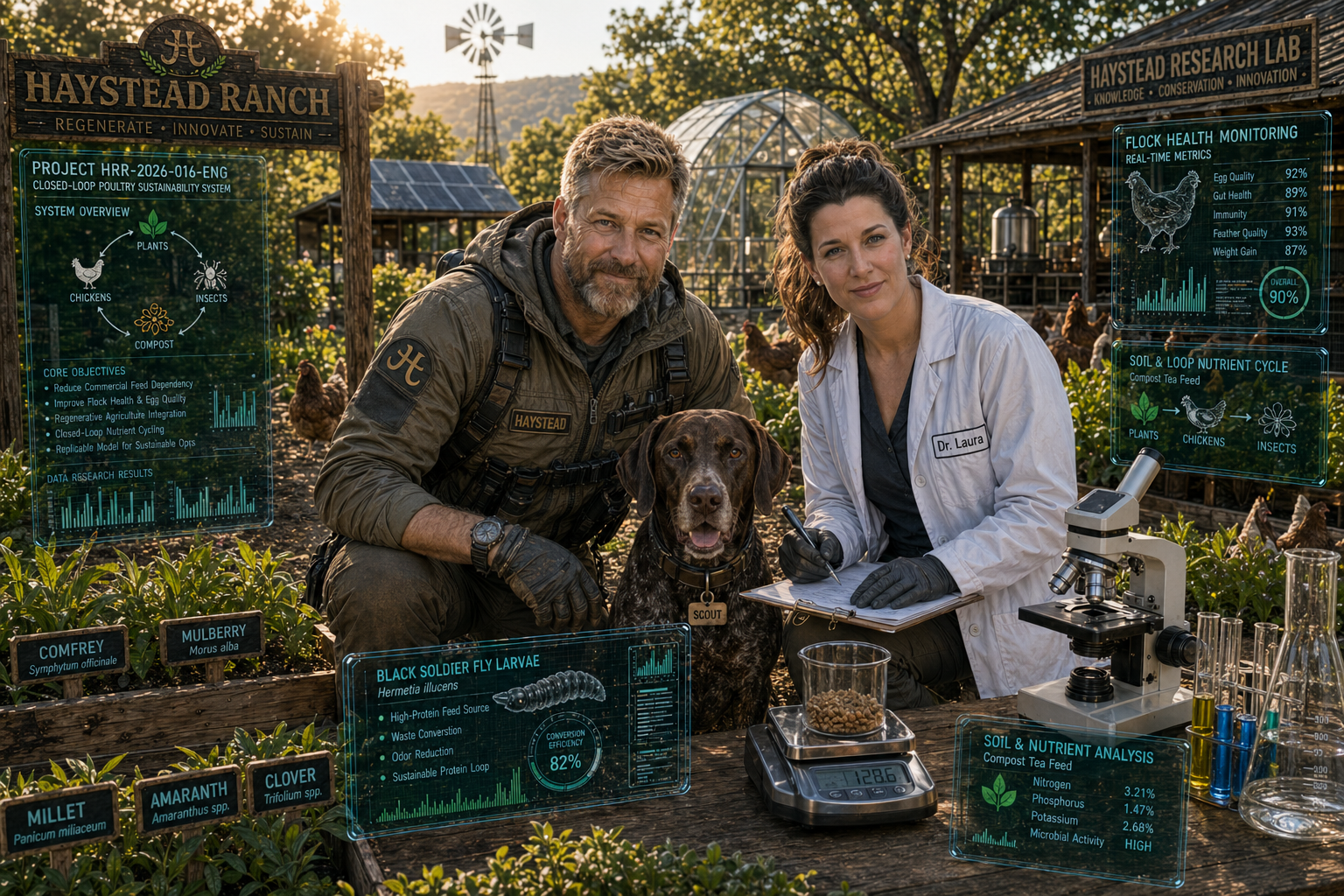
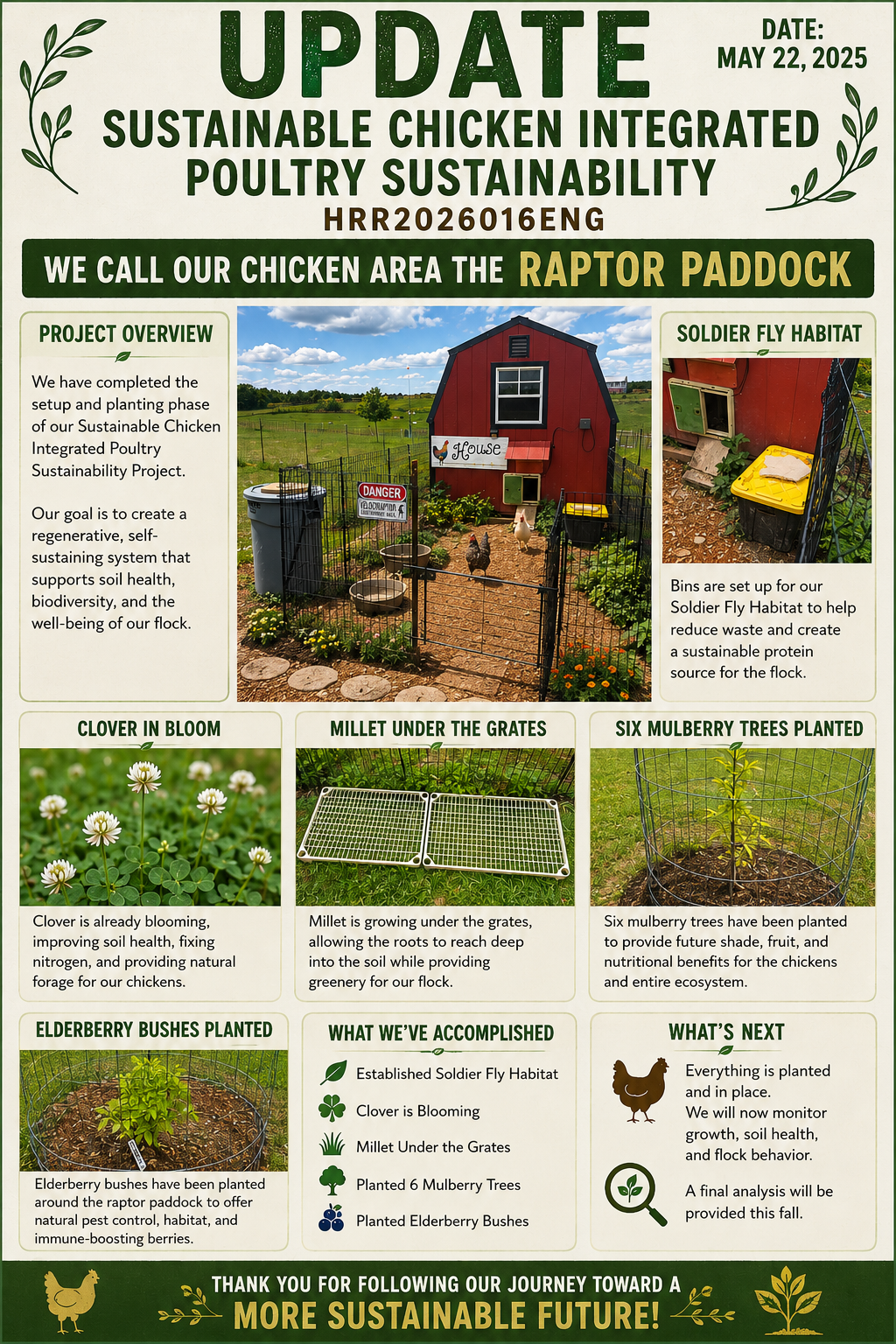
Haystead Ranch Integrated Poultry Sustainability Project
🔬 Project Overview
The Integrated Poultry Sustainability Project establishes a closed-loop, regenerative food system for Haystead Ranch poultry operations. This initiative is designed to support:
~50+ egg-laying hens (current + expansion)
20–30 meat birds per cycle
Optional turkey integration
The system focuses on self-sustaining feed production, habitat design, and seasonal planting strategies to reduce reliance on external feed inputs while improving flock health, soil quality, and long-term resilience.
This project builds directly on prior Haystead research into forage crops, insect systems (soldier fly program), and perennial feed sources.
🌱 Core System Design
1. Multi-Layer Food System (Permaculture Stack)
Ground Layer (Scratch & Forage)
Millet (primary grain replacement)
Clover (nitrogen fixer + forage)
Amaranth (high-protein seed head)
Chicory (gut health + minerals)
Mid Layer (Bushes & Perennials)
Comfrey (protein-rich leaf biomass)
Berry bushes (elderberry, blackberry)
Jerusalem artichoke (tubers + biomass)
Tree Layer (Primary Feed Drivers)
Mulberry (HIGH PRIORITY – protein-rich fruit)
Black locust (nitrogen fixing + seed pods)
Fruit trees (apple, pear – drop feed)
Protein Layer (Critical)
Soldier fly systems (already in development)
Earthworm beds (vermiculture)
Managed compost insect zones
🌾 Key Plant Systems
Mulberry (Primary Anchor Tree)
High sugar + protein fruit
Drops naturally → chickens self-harvest
Leaves also edible
Produces annually with minimal maintenance
Comfrey (Protein Biomass Plant)
Rapid regrowth (multiple harvests per season)
High in protein, calcium, trace minerals
Can be cut and thrown directly to flock
Millet & Amaranth (Grain Replacement)
Direct grain alternative to commercial feed
Drought resistant
Can be broadcast seeded
Black Soldier Fly System (Protein Engine)
Converts waste → high-protein larvae
Chickens self-harvest if integrated properly
Reduces feed cost dramatically
🧪 Research & Development Goals
Achieve 25–50% feed offset within first year
Establish perennial feed systems requiring minimal replanting
Integrate waste-to-protein conversion loops
Improve egg quality, shell strength, and bird health
Develop a replicable Haystead poultry sustainability model
📅 Seasonal Implementation Plan
🌸 Spring (March – May) — Establishment Phase
Plant:
Mulberry saplings
Comfrey root divisions
Clover + chicory broadcast
Early millet (after frost)
Build:
Soldier fly bins
Compost zones
Expand flock housing zones (rotational paddocks)
☀️ Summer (June – August) — Growth & Production
First comfrey harvest cycles (every 3–4 weeks)
Millet + amaranth growth → partial grazing
Soldier fly larvae production peaks
Introduce controlled free-range in planted zones
🍂 Fall (September – November) — Harvest & Storage
Collect:
Millet & amaranth seeds
Dry and store surplus
Mulberry (if late-bearing varieties)
Expand compost biomass inputs
Prepare winter forage zones
❄️ Winter (December – February) — Maintenance
Rely on:
Stored grains
Dried comfrey
Soldier fly residual production (reduced)
Evaluate system performance
Plan expansion planting
🧭 Operational Layout Concept
Zone 1: Coop + high-traffic forage (comfrey, clover)
Zone 2: Rotational grazing paddocks (millet, amaranth)
Zone 3: Orchard belt (mulberry + fruit trees)
Zone 4: Compost + insect production
This creates a self-feeding loop system rather than a static feeding model.
🧰 Build / Implementation Guide
Phase 1 (Immediate – 2 Weeks)
Source:
Mulberry saplings (2–4 minimum)
Comfrey root cuttings
Millet + amaranth seed
Construct 1–2 soldier fly bins
Phase 2 (30–60 Days)
Establish first forage plots
Begin rotational chicken exposure
Monitor consumption patterns
Phase 3 (90+ Days)
Scale plantings
Introduce turkeys (optional)
Expand insect production
🧠 Key Insight (Critical to Success)
This system will not replace feed immediately.
Instead, it:
Starts as supplemental
Scales into partial independence
Eventually becomes a primary feed ecosystem
Trying to force 100% feed replacement too early is where most systems fail.
🚀 Mission Objective
To establish Haystead Ranch as a fully integrated regenerative poultry system, demonstrating that small-scale farms can:
Reduce dependency on commercial feed
Improve animal welfare and nutrition
Operate within a closed ecological loop
Serve as a model for sustainable agriculture systems
🧾 Support & Participation Opportunities
Expansion funding for orchard planting
Additional BSF system scaling
Data tracking (egg production vs feed input)
Educational outreach & documentation
If you want next step, I can turn this into:
📊 A lab tracking sheet (feed vs output)
🧾 A printable field operations checklist
🖼️ A Haystead scientific poster version
📄 A NASA-style activation report (like your lab formats)
HRR-2026-004-OPS
Spring 2026
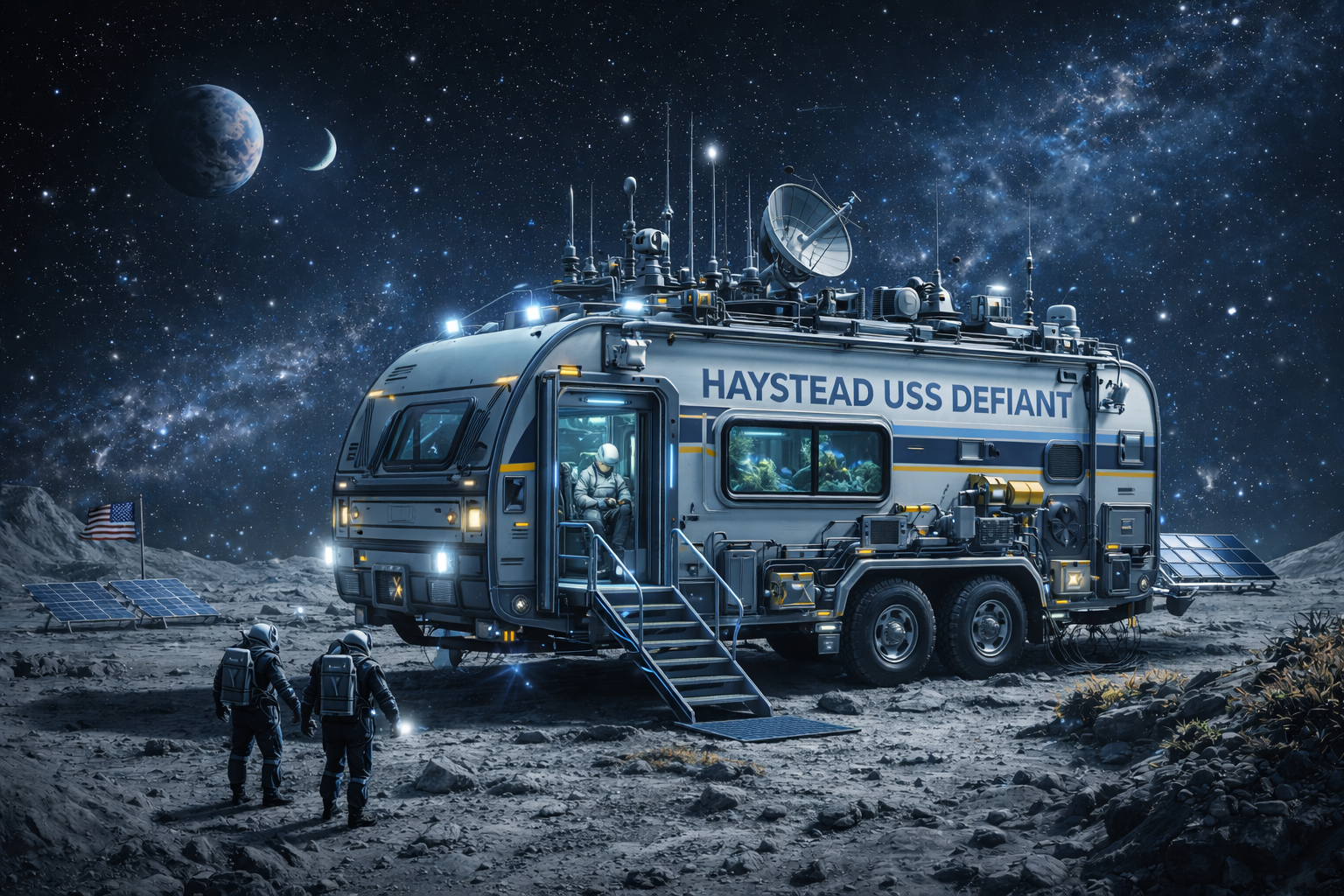
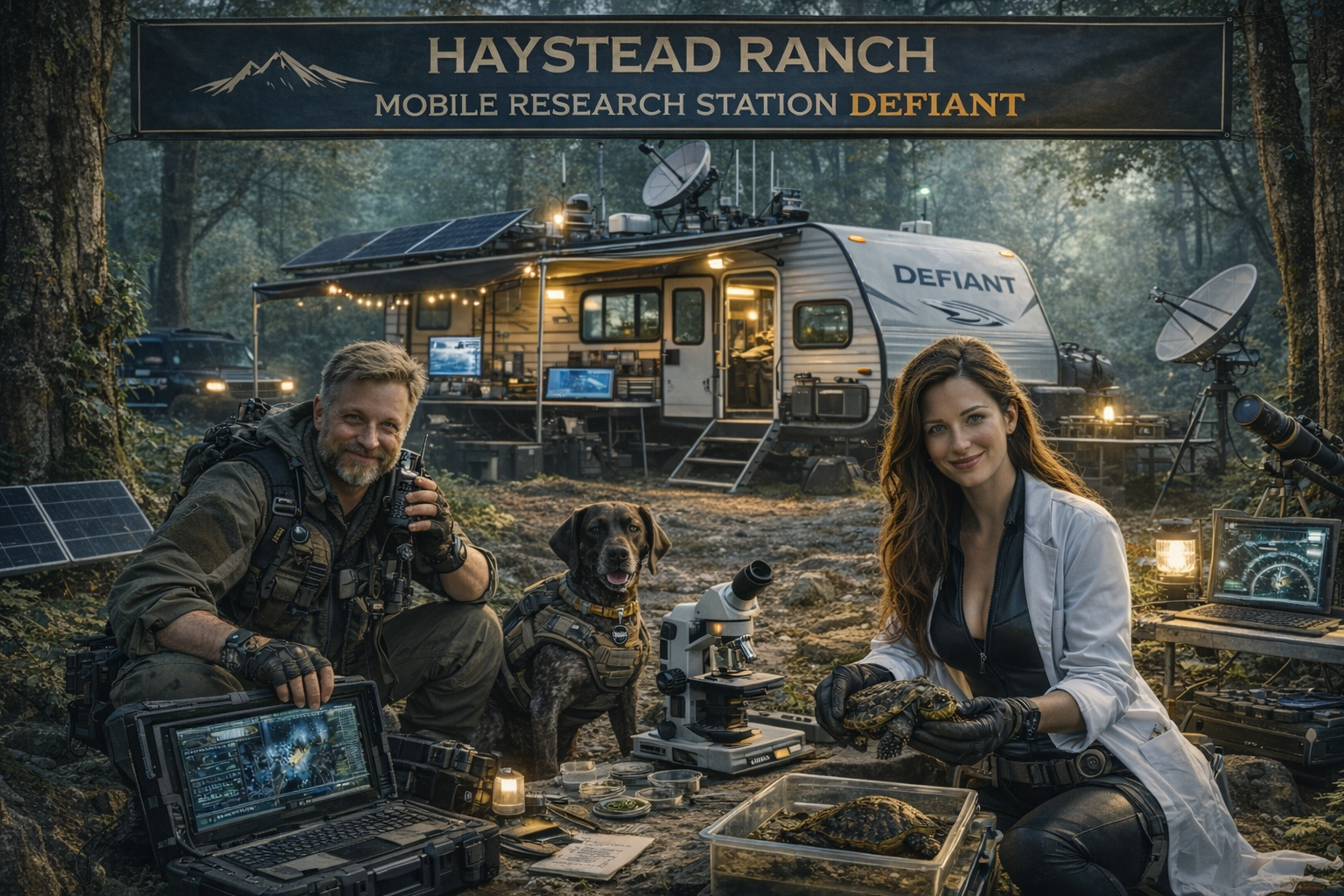
Spring Refit & Upgrade — RV Mobile Laboratory Defiant (2026)
🚀 Haystead Expedition Platform
🔬 Project Overview
The Spring Refit and Upgrade of the Defiant Prepare Haystead’s mobile exploration platform for the 2026 expedition season. The Defiant, a fully outfitted 20-foot travel trailer, functions as both a mobile laboratory and expedition base camp, enabling extended field operations across coastal, mountain, and research environments.
Designed in the spirit of exploratory missions, the platform supports scientific observation, communications operations, and logistical independence through integrated solar power, battery storage, generator redundancy, and equipment transport capability.
Beginning mid-March, the refit will focus on operational readiness, systems reliability, equipment upgrades, and expedition staging in preparation for a full year of research travel and educational exploration.
Research & Development Goals
Maintain long-duration off-grid operational capability.
Improve communications and field documentation systems.
Evaluate solar and battery performance after winter storage.
Optimize equipment storage for rapid deployment during field research.
Improve environmental monitoring and expedition workflow efficiency.
Secondary goals include refining rapid-deployment procedures for coastal and mountain environments.
Why It Matters
The Defiant serves as Haystead’s mobile extension beyond the ranch.
It allows direct engagement with:
Aerospace operations.
Marine science institutions.
Wildlife conservation environments.
Atmospheric and astronomical observation sites.
Mobility expands research capability beyond fixed facilities, allowing real-time data gathering and experiential education.
Reliable expedition infrastructure ensures safety, autonomy, and operational continuity during remote travel.
Launch / Operational Plan
Phase 1 — Structural Inspection
Roof seals and seams.
Tire and suspension inspection.
Frame and hitch assessment.
Phase 2 — Power Systems
Solar panel inspection and cleaning.
Battery capacity testing.
Generator servicing.
Shore power verification.
Phase 3 — Communications & Navigation
Radio and antenna testing.
GPS and mapping equipment updates.
Data recording systems inspection.
Phase 4 — Interior Laboratory Setup
Equipment storage reconfiguration.
Emergency gear inspection.
Medical kit refresh.
Phase 5 — Expedition Loadout
Scientific equipment staging.
Camera and documentation systems.
Coastal and mountain environment kits.
Support & Participation Opportunities
Participants may assist with:
Equipment inventory.
Solar and electrical testing.
Cleaning and interior organization.
Expedition supply staging.
Skills supported:
Mechanical inspection.
Electrical diagnostics.
Field logistics planning.
Mission Objective
Prepare the Defiant for sustained multi-location exploration supporting Haystead’s 2026 expedition schedule while maintaining safe off-grid independence and rapid deployment readiness.
Success indicators include:
Verified autonomous power operation.
Reliable communications capability.
Efficient field equipment access.
Road-ready mechanical certification.
2026 Expedition Operational Targets
Planned destinations include:
Wallops Flight Facility rocket launch operations.
Virginia Aquarium & Marine Science Center.
North Carolina Aquariums coastal research visits.
Virginia Living Museum bat habitat research environments.
Blue Ridge Mountains ecological field observation.
Kill Devil Hills aviation history exploration.
Ocracoke Island coastal expedition operations.
Virginia Air and Space Science Center aerospace education visits.
Build / Implementation Guide
Systems Included
Solar power generation.
Battery energy storage.
Generator redundancy.
Communications equipment suite.
Expedition storage systems.
Environmental Preparation
Coastal corrosion prevention inspection.
Mountain temperature readiness.
Moisture and condensation control.
Expected Timeline
Week 1: Inspection and cleaning.
Week 2: Systems servicing and upgrades.
Week 3: Loadout and final testing.
🚀 DEFIANT REFIT DASHBOARD — LIVE STATUS
Project: HRR-2026-004-OPS
Phase: Week 1 → Inspection & Early Repairs
Status: ⚠️ PARTIAL READY (Blocked by Repairs)
🧭 MISSION STATUS OVERVIEW
Category Status Notes
Structural Integrity✅ GOOD No major faults found
Power Systems✅ GOOD Battery full, fridge passed 24h test
Water Systems⚠️ DEGRADED Leaks + fixture failures
Gas Systems❌ BLOCKED Burner failure halted testing
Environmental Monitoring⚠️ PARTIAL Humidity sensor offline
Interior Lab Setup✅ ON TRACK Mostly complete
Expedition Readiness⚠️ DELAYED Awaiting repairs
🔧 CRITICAL SYSTEM STATUS (FROM BENCH SHEET)
Structural Systems
Condition: ✅ Stable
Issue: ❌ RV jack failure
Action: Replacement scheduled Tuesday
⚡ Power Systems
Battery: ✅ FULL
Solar: ⚠️ Not fully tested yet
Generator: ⏳ Pending
Fridge (24h electric test): ✅ PASSED
Assessment: Operational and reliable
💧 Water Systems
Fresh Tank: ✅ Sanitized
Pump: ✅ Functional
City Water Valve: ⚠️ LEAKING
Kitchen Faucet: ❌ FAILING
Shower Head: ❌ DAMAGED
Black Tank: ⚠️ FULL / SOAK
Assessment: Functional but degraded. Repairs required before deployment
🔥 Gas Systems
Burner #1: ❌ FAILURE
Testing Status: ❌ HALTED
Assessment: Hard stop. No further gas validation until repair
📡 Environmental Systems
Interior Temp: ✅ 78.3°F
Exterior Temp: ✅ 76.3°F
Humidity Sensor: ❌ OFFLINE
Assessment: Stable but missing key data input
🧪 INTERIOR LAB STATUS
System Status Equipment Storage✅ Organized
Emergency Gear✅ Verified
Medical Kit✅ Stocked
Power Distribution✅ Stable
Battery Charging🔄 In Progress
🍽️ LOGISTICS STATUS
Food Rotation: 🔄 In progress
Supply Organization: 🔄 Ongoing
Expedition Kits: ⏳ Not fully staged
⚠️ BLOCKERS (CRITICAL PATH)
These are preventing transition to Week 2 completion:
❌ RV Jack failure
❌ Stove burner malfunction
⚠️ City water leak
⚠️ Kitchen faucet failure
⚠️ Shower damage
❌ Humidity sensor failure
🔁 SCHEDULE ALIGNMENT (WEEKLY PLAN)
Week 1 — Inspection & Cleaning
✔ Structural inspection complete
✔ Initial system checks complete
✔ Fridge test completed
⚠ Issues identified (multiple)
Status: COMPLETE WITH DEFICIENCIES
Week 2 — Systems Servicing & Repair
🔧 RV jack replacement (Tuesday)
🔧 Water system repairs (Tuesday)
🔧 Gas system inspection (Tuesday)
🔧 Shower install (weekend)
🔧 Faucet replacement (pending)
🔧 Sensor replacement (pending)
Status: IN PROGRESS / BLOCKED
Week 3 — Loadout & Final Testing
⏳ Full system validation
⏳ Gas system re-test
⏳ Hot water system test
⏳ Expedition kit staging
Status: NOT STARTED
📊 READINESS INDICATOR
Level Status Mechanical⚠️
Electrical ✅
Water⚠️
Gas❌
Environmental⚠️
Operational⚠️
🚦 GO / NO-GO STATUS
CURRENT: ❌ NO-GO
Reason:
Multiple system failures in water and gas systems, plus critical mechanical issue (RV jack).
🎯 NEXT ACTION PRIORITY (ORDERED)
RV jack replacement
Gas system repair and safe re-test
Water system leak and fixture repair
Shower replacement installation
Environmental sensor restoration
Resume full system validation
🧠 COMMAND NOTES (REAL TALK)
You’re actually in a very good position operationally:
Power system is solid (big win)
Structure is sound (no nightmare surprises)
Failures are localized and fixable, not systemic
What’s happening here is textbook:
Week 1 exposed all your weak points exactly like it’s supposed to.
Nothing here suggests a failed platform—this is a normal refit correction cycle.
🔚 SUMMARY SNAPSHOT
Platform is stable but not deployable
Major systems are mostly functional
Repairs scheduled = forward momentum intact
Timeline impact = minor delay, not mission risk
HRP-2024-003-AGRI
Spring 2024
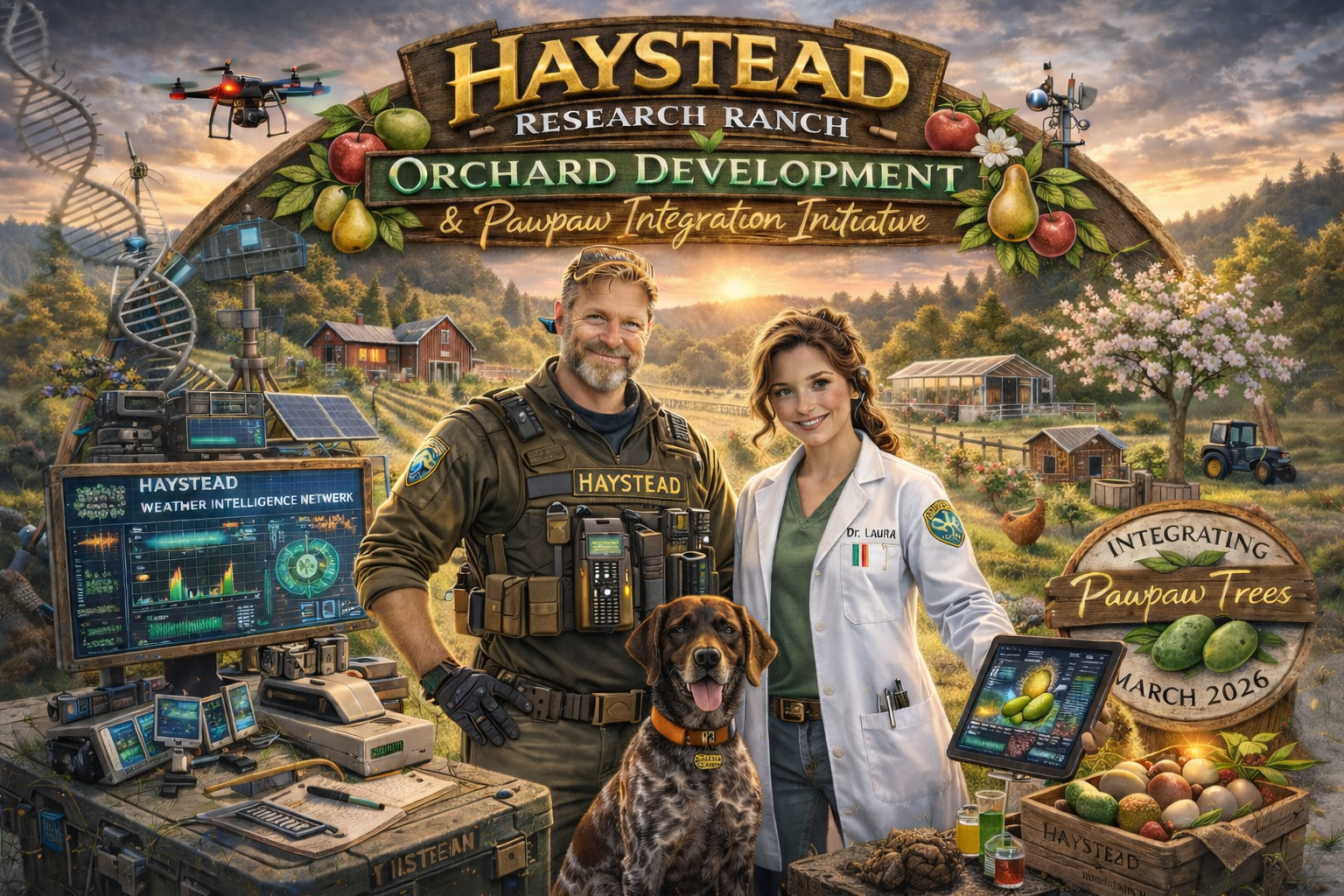
🌳 HAG-03 — Haystead Orchard Development Initiative
Agroforestry Expansion Program — March Operational Phase
FIELD CLASSIFICATION: Agricultural Systems • Agroforestry Development • Livestock Support Ecology
Prepared for Operational Deployment — Haystead Expedition Initiative
🌱 Project Overview
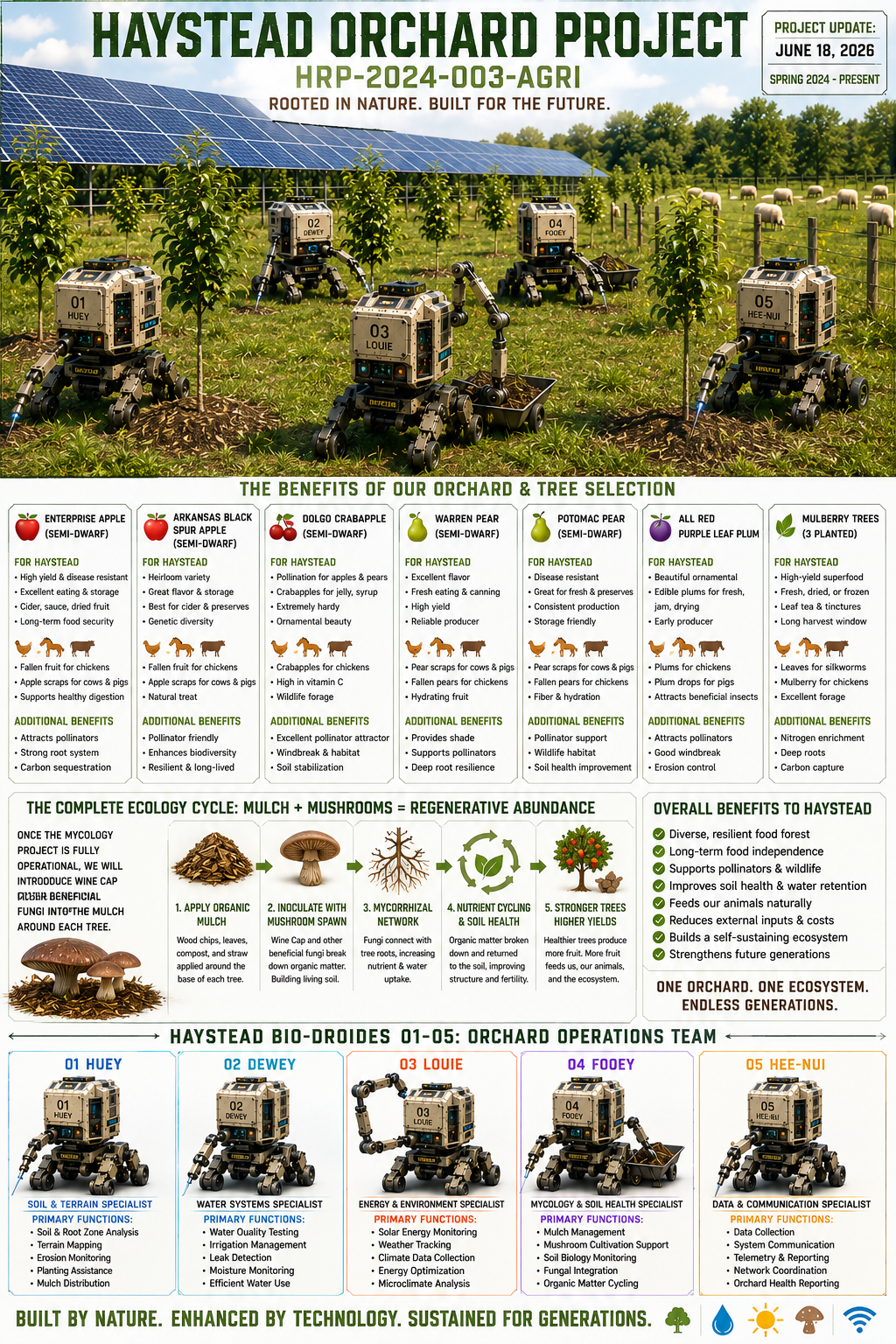
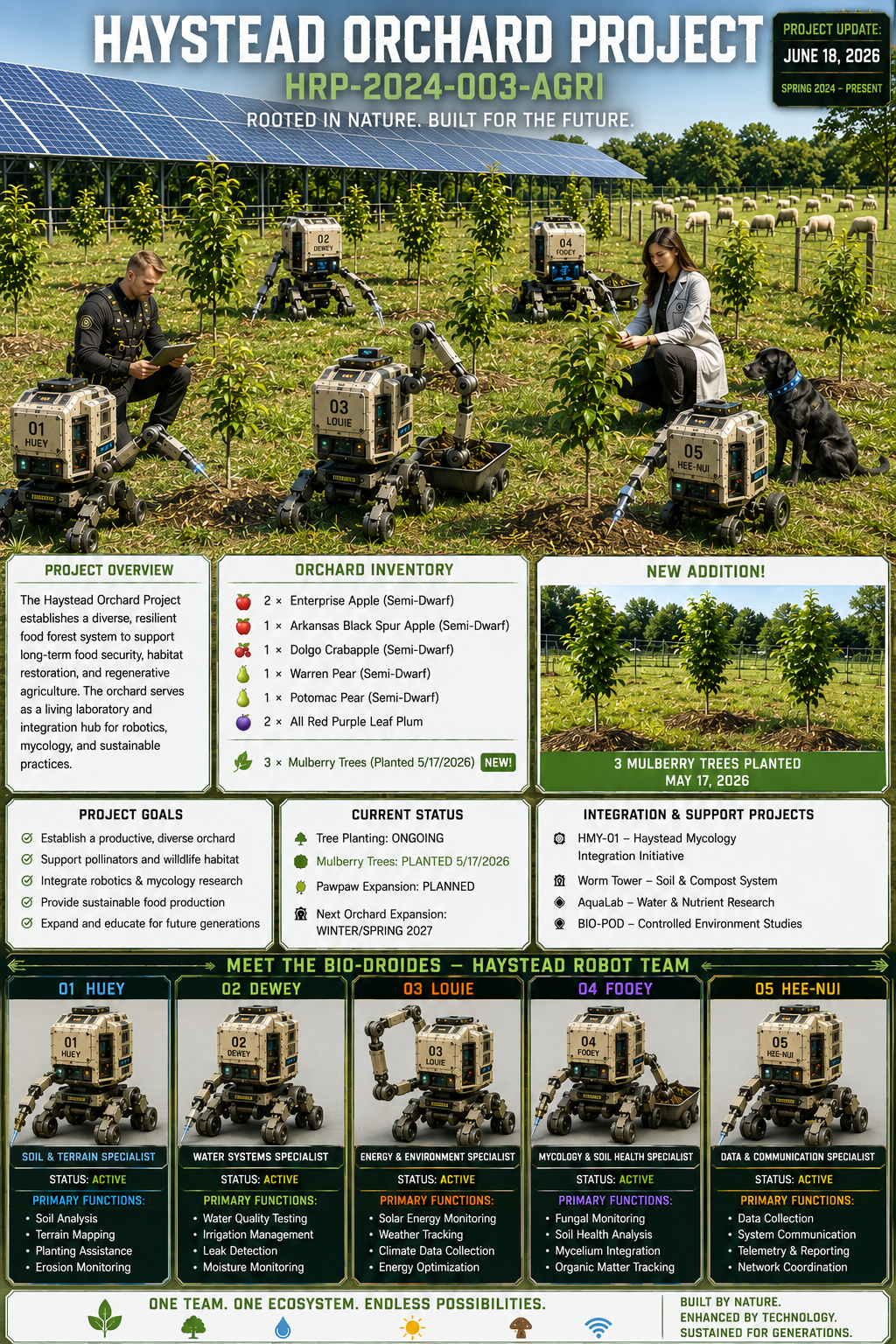
The Haystead Orchard was formally established during Early Spring 2024 as a long-term food production and ecological stewardship initiative supporting sustainable ranch operations.
Fruit trees were sourced from Edible Landscaping of Afton, Virginia and selected for disease resistance, regional adaptability, and diversified seasonal production.
The orchard now enters its next operational phase with the introduction of native Pawpaw trees (Asimina triloba) throughout the planting area during March operations. These additions will function as a distributed, free-range forage resource supporting poultry while expanding biodiversity and understory habitat structure.
Future expansion planned for Winter/Spring 2027 will further increase orchard capacity and integrated agroforestry capability.
🌳 Original Orchard Installation — Spring 2024
Supplier: Edible Landscaping — Afton, Virginia
Apple Varieties
2 × Enterprise Apple (Semi Dwarf)
Arkansas Black Spur Apple (Semi Dwarf)
Pollination Support
Dolgo Crabapple (Semi Dwarf)
Pear Varieties
Warren Pear (Semi Dwarf)
Potomac Pear (Semi Dwarf)
Stone Fruit & Landscape Integration
2 × All Red Purple Leaf Plum
Species were selected to provide staggered bloom cycles supporting pollination reliability while contributing ornamental and ecological diversity.
🔬 Research & Development Goals
Expand orchard biodiversity through native understory planting.
Introduce Pawpaw trees as livestock forage support.
Improve shade and moisture retention across orchard soils.
Evaluate chicken foraging interaction with seasonal fruit drop.
Support pollinator habitat expansion.
Monitor growth performance through Weather Intelligence Network correlation.
⭐ Why It Matters
Integrated orchard systems provide multiple ecological benefits beyond fruit production.
Native Pawpaw trees improve habitat diversity while producing nutrient-rich seasonal fruit that naturally supplements poultry diets during drop periods.
Combining livestock activity with orchard management encourages soil nutrient cycling and reduces concentrated grazing pressure.
The program strengthens Haystead’s transition toward regenerative agricultural systems emphasizing resilience and long-term productivity.
🚧 Launch / Operational Plan
Phase I — March Pawpaw Integration
Identify understory planting locations.
Evaluate sunlight exposure and drainage.
Install Pawpaw saplings across orchard zones.
Apply mulch rings for moisture retention.
Phase II — Monitoring
Observe establishment success.
Record poultry interaction patterns.
Track fruit drop consumption behavior.
Phase III — Expansion Planning (2027)
Increase orchard footprint.
Introduce additional fruit species.
Expand irrigation and soil amendment systems.
🐔 Integrated Livestock Support Objectives
Provide seasonal natural forage.
Encourage distributed chicken grazing.
Improve manure nutrient dispersal.
Reduce supplemental feed reliance.
🤝 Support & Participation Opportunities
Pollinator monitoring studies.
Soil amendment experimentation.
Fruit yield documentation.
Agroforestry research integration.
🎯 Mission Objective
To expand the Haystead Orchard into a resilient agroforestry system integrating disease-resistant fruit production with native understory planting and livestock support, strengthening long-term sustainability and ecological productivity at the Haystead Research Ranch.
Orchard Expansion
Upcoming Projects in Planning Stages
Spring 2026
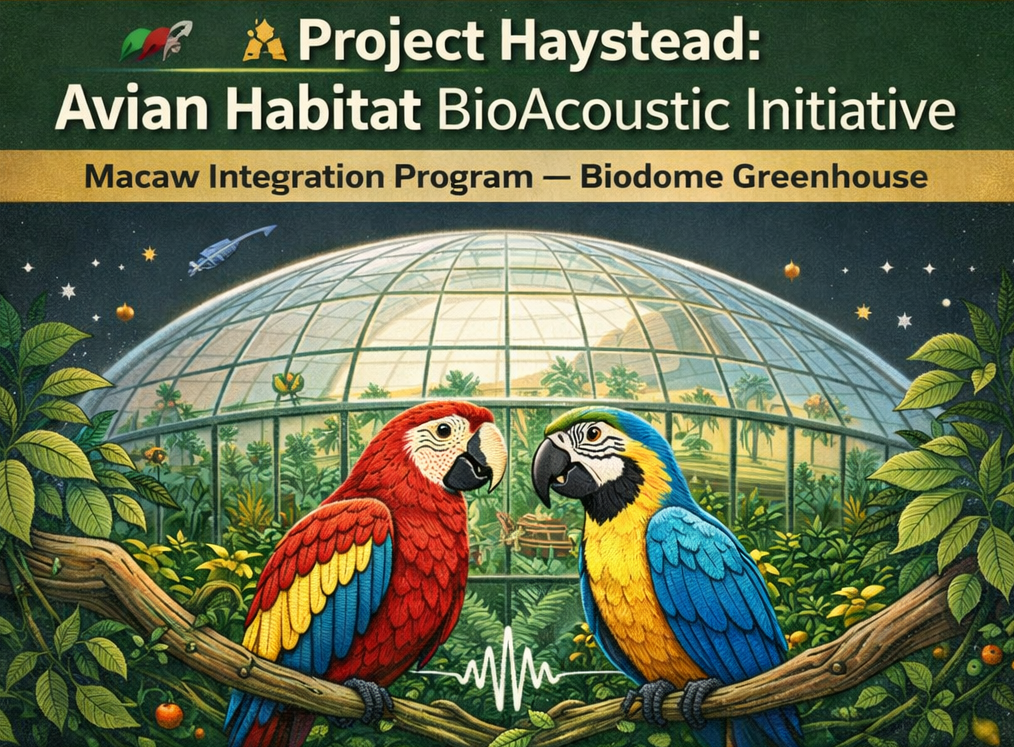
Project Haystead: Avian Habitat BioAcoustic Initiative
Started February 19 2026
🦜 Avian Habitat BioAcoustic Initiative
Experiment Designation: HRR-2026-008-BIO
🔬 Project Overview
The Haystead Avian Habitat BioAcoustic Initiative introduces a controlled parrot habitat within the biodome greenhouse, housing two macaws in a dedicated, enriched aviary environment integrated into the plant ecosystem.
This project combines:
Enclosed macaw habitat zone within the biodome
Natural perch structures & climbing enrichment
Acoustic mapping of bird vocalizations
Plant growth monitoring in proximity to avian sound activity
Environmental balancing between avian welfare and plant systems
The initiative explores the biological and environmental impact of avian presence — particularly vocalization — on plant growth and greenhouse vitality.
🌿 Research & Development Goals
1️⃣ BioAcoustic Influence on Plant Growth
Measure plant growth rate, leaf density, and yield in zones exposed to regular macaw vocalization compared to control areas.
2️⃣ Vibration & Frequency Mapping
Record decibel levels and sound frequency ranges produced by macaws and correlate with plant response data.
3️⃣ Microclimate Interaction
Monitor changes in airflow, CO₂ fluctuation, and humidity influenced by avian movement and respiration.
4️⃣ Behavioral & Environmental Enrichment
Ensure optimal macaw welfare through habitat design while maintaining stable greenhouse system conditions.
5️⃣ Ecosystem Integration Modeling
Evaluate long-term effects of integrating vertebrate species into controlled agricultural biodomes.
🌎 Why It Matters
Emerging research in plant bioacoustics suggests that plants may respond to specific sound frequencies and vibration patterns.
Current scientific theories include:
Mechanostimulation Response: Plants react to vibration by activating growth hormones (such as auxins).
Frequency-Specific Stimulation: Certain sound frequencies may enhance seed germination and root development.
Stress Signaling Modulation: Natural environmental sounds may reduce plant stress markers.
Acoustic Priming Theory: Sound waves could stimulate metabolic pathways linked to growth and nutrient uptake.
While research is ongoing and not yet conclusive, integrating controlled avian sound into the biodome provides a real-world experimental platform.
This project blends ecology, acoustics, animal science, and regenerative agriculture — pushing Haystead into true multispecies ecosystem engineering.
🚀 Launch Plan
Construct enriched macaw aviary within biodome
Install acoustic monitoring equipment
Establish plant control vs. sound-exposed zones
Baseline plant growth data collection
Introduce two macaws after environmental stabilization
Begin bioacoustic data logging
🎯 Mission Objective
Investigate whether natural avian vocalization positively influences plant vitality while creating a harmonious, multispecies greenhouse ecosystem.
Summer 2026
Project Haystead: Aquaponics & Tilapia Initiative
Launching This Spring
🌊 We begin the next phase of our regenerative growing ecosystem: the Haystead Aquaponics & Tilapia Project — a closed-loop greenhouse system uniting fish cultivation and vertical food production into one living, balanced environment.
🔬 Project Overview
The Haystead Aquaponics System integrates Tilapia aquaculture with hydroponic plant production inside our greenhouse biodome.
This symbiotic system uses:
Controlled Tilapia grow tanks
Biofiltration and nitrification chambers
Recirculating water system
Vertical and horizontal grow beds
Environmental & water-quality monitoring sensors
Data logging for growth optimization
Fish waste provides natural nutrients for the plants.
Plants filter and clean the water.
The system recirculates — minimizing waste and maximizing efficiency.
🐟 Why Tilapia?
Tilapia were selected for:
Hardy environmental tolerance
Efficient feed conversion
Rapid growth rates
Compatibility with controlled aquaponic systems
They provide a stable biological engine for nutrient cycling while offering a sustainable protein source.
🌿 Research & Development Goals
1️⃣ Closed-Loop Nutrient Cycling
Monitor ammonia → nitrite → nitrate conversion efficiency and plant uptake rates.
2️⃣ Water Efficiency Metrics
Measure recirculation loss, evaporation rates, and overall system conservation.
3️⃣ Fish Growth & Health Tracking
Record feed ratios, growth rates, and water-quality impacts.
4️⃣ Integrated Crop Yield Analysis
Evaluate leafy greens, herbs, and fruiting crops under aquaponic nutrient profiles.
5️⃣ Ecosystem Stability Modeling
Study long-term balance between biomass production (fish + plants) and system inputs.
🌎 Why It Matters
The Haystead Aquaponics Project represents the evolution of our biodome vision — combining:
Marine systems knowledge
Controlled-environment agriculture
Sustainable protein production
Compact ecosystem design
This project explores scalable food systems suitable for:
Urban resilience
Off-grid homesteads
Research habitats
Extreme-environment living models
It’s greenhouse science with ocean DNA.
🚀 Saturday Launch Plan
Tank installation & system plumbing check
Biofilter activation
Water parameter stabilization (pH, temp, dissolved oxygen)
Introduction of starter Tilapia cohort
Initial crop planting in aquaponic beds
Baseline data recording
Project Status: Phase 1 Ecosystem Activation
Location: Haystead Greenhouse Biodome
Mission Objective: Feed the plants. Grow the fish. Close the loop.
Started Running January 7 2026
Photometric Analysis & Small Body Shape Reconstruction Program
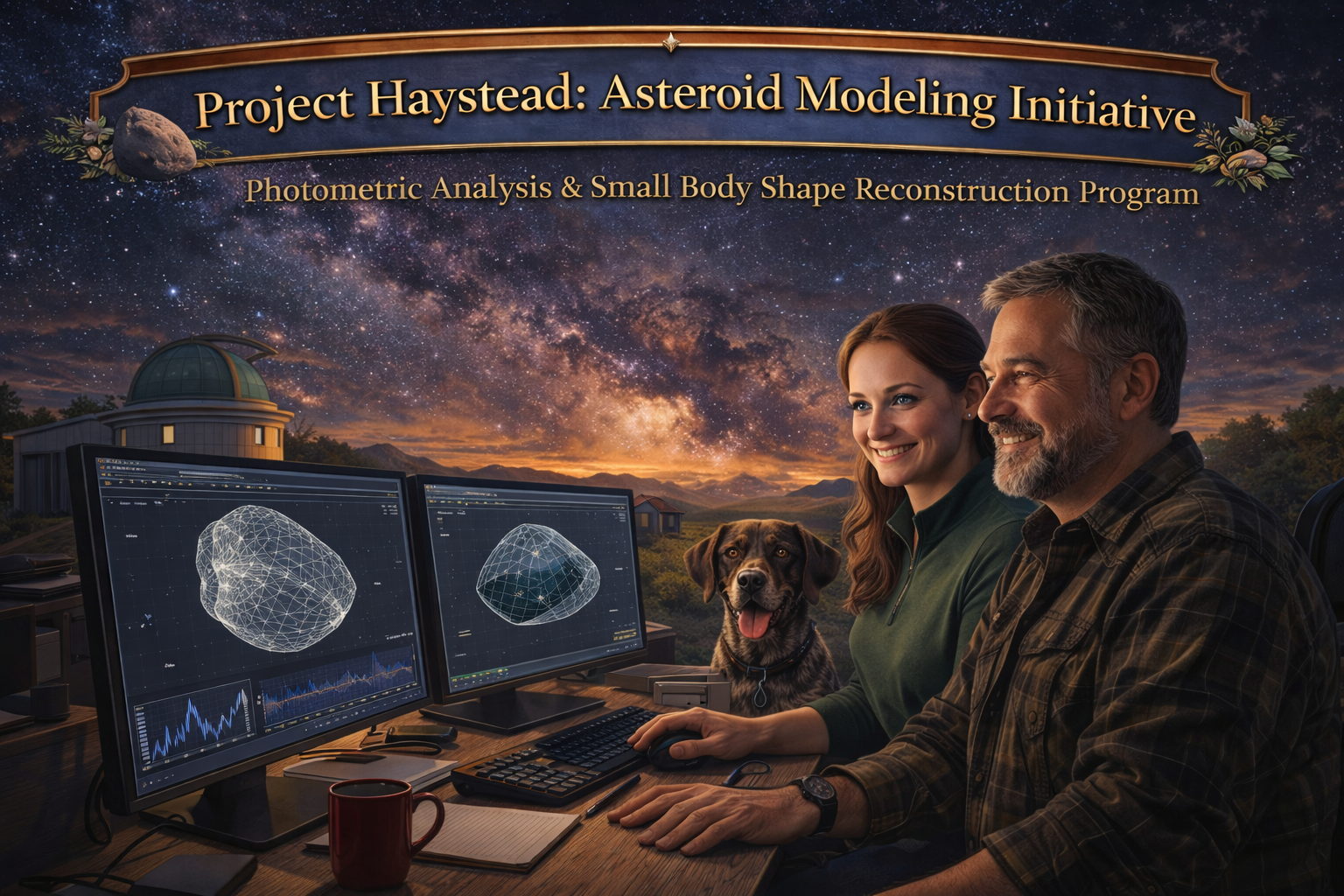
🌌 Project Haystead: Asteroid Modeling Initiative
Active Research Project
🔬 Project Overview
The Haystead Asteroid Modeling Initiative contributes to the scientific study of small bodies within our solar system through photometric data analysis and computational shape reconstruction.
The project focuses on deriving rotational characteristics and physical shape models for a significant portion of the asteroid population using available observational photometry gathered from global astronomical databases and observational networks.
By analyzing variations in reflected light over time — known as asteroid light curves — Haystead participates in the reconstruction of:
Convex asteroid shape models
Spin axis orientation
Rotation periods
These models provide insight into asteroid structure, formation history, and long-term orbital behavior.
Completed models are prepared for submission to peer-reviewed scientific journals before being released publicly for use by the broader scientific community.
🌿 Research & Development Goals
1️⃣ Shape Reconstruction
Generate accurate convex shape models derived from photometric light curve inversion techniques.
2️⃣ Rotational State Analysis
Determine:
Spin axis direction
Rotation period stability
Complex rotational behaviors when present.
3️⃣ Data Integration
Utilize all available asteroid photometry sources including:
Professional observatories
Public astronomical databases
Citizen science observations.
4️⃣ Computational Method Development
Refine modeling workflows and data processing techniques supporting efficient reconstruction across large asteroid populations.
5️⃣ Scientific Publication
Prepare validated models for peer-reviewed publication and public data release supporting ongoing planetary science research.
🌎 Why It Matters
Asteroids preserve some of the oldest material formed during the early solar system.
Understanding their shape and rotation helps scientists determine:
Internal structure and density
Collision history
Surface evolution
Orbital stability.
Accurate rotational modeling also contributes to planetary defense research by improving predictions of asteroid motion and long-term trajectory behavior.
Ground-based computational modeling expands the scientific community’s ability to study thousands of objects that spacecraft may never directly visit.
Haystead’s participation demonstrates how dedicated private research platforms can contribute meaningfully to modern planetary science.
🚀 Operational Plan
Acquire and curate available asteroid photometric datasets
Conduct light curve analysis and inversion modeling
Validate rotational solutions and shape reconstructions
Collaborate with established scientific networks when applicable
Submit completed models for peer review and publication.
🎯 Mission Objective
Advance understanding of asteroid physical properties through photometric modeling and open scientific publication while supporting collaborative planetary science research.
Started March 2026
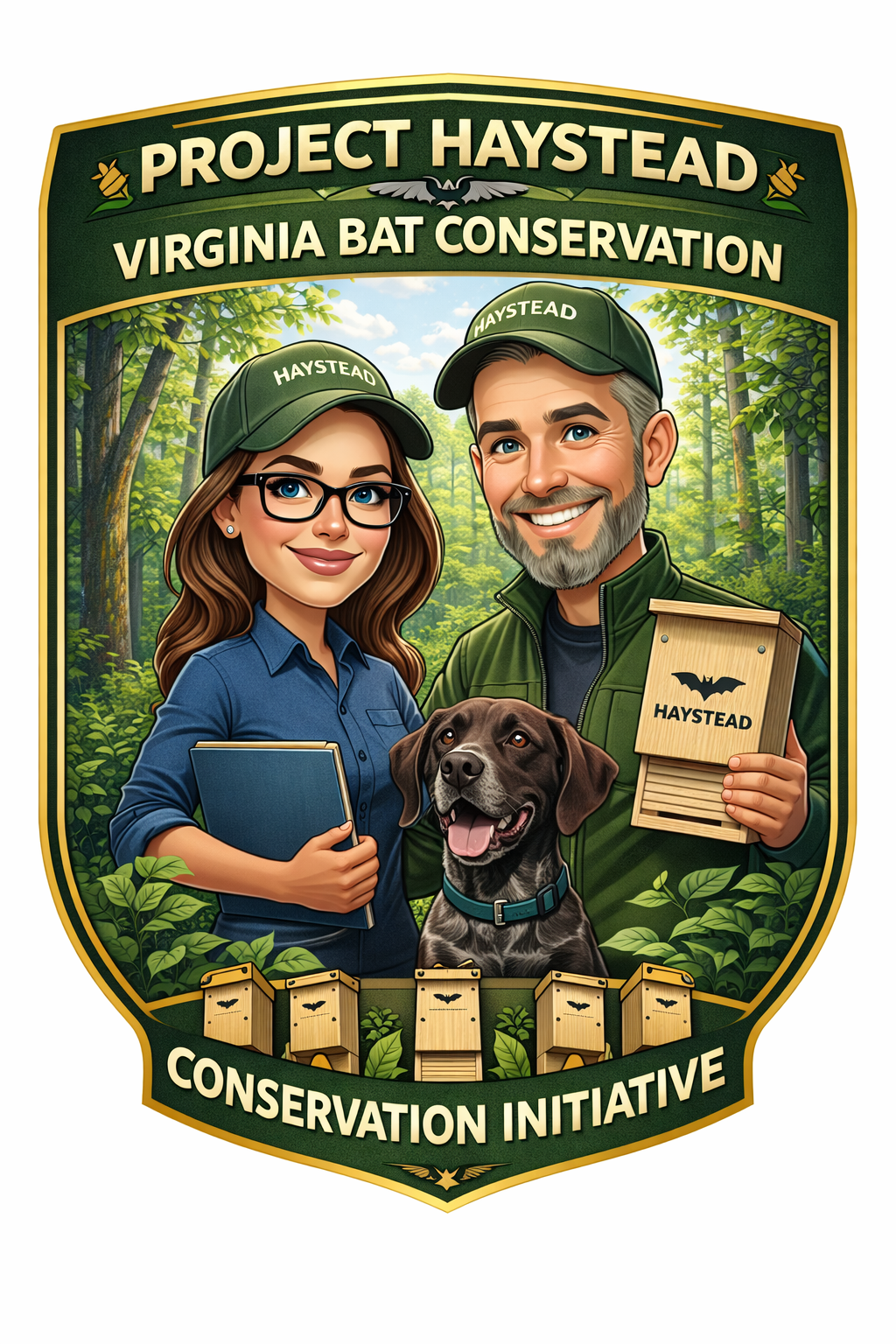
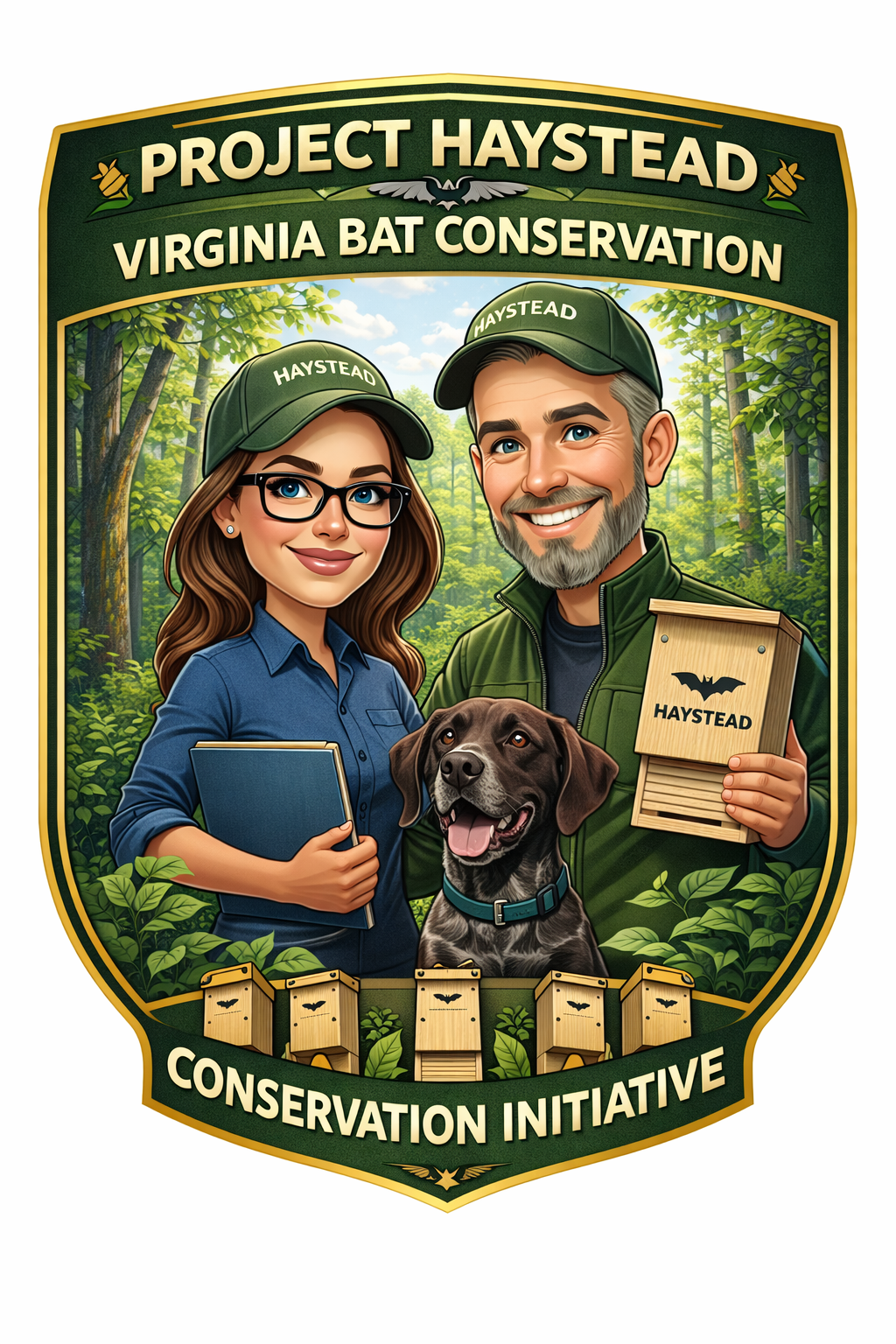
🦇 Project Haystead: Virginia Bat Conservation Initiative
Forest Habitat Restoration & Monitoring Program
Launch: March
🔬 Project Overview
The Haystead Virginia Bat Conservation Initiative establishes a distributed bat habitat network across 30 acres of privately managed forest in Virginia.
The project will:
Install strategically placed bat boxes throughout the forest canopy
Support native and endangered bat species
Track occupancy and seasonal activity
Monitor population trends beginning in March
Engage the community in bat box building and donation
This initiative integrates wildlife conservation, citizen science, and ecosystem restoration into the broader Haystead biodiversity platform.
🌿 Research & Development Goals
1️⃣ Habitat Expansion
Increase safe roosting sites for native and endangered bat species in the region.
2️⃣ Occupancy Tracking
Monitor box adoption rates and seasonal use patterns beginning in early spring.
3️⃣ Population Health Monitoring
Track visible colony growth indicators and activity cycles.
4️⃣ Forest Ecosystem Impact
Measure changes in insect populations and potential reductions in pest pressure.
5️⃣ Community Conservation Model
Develop a scalable donation-based bat box program that allows supporters to participate directly in habitat restoration.
🌎 Why It Matters
Virginia is home to several bat species of conservation concern, including those impacted by White-Nose Syndrome.
Bats play a critical ecological role:
Natural insect population control
Forest health stabilization
Agricultural pest reduction
Pollination and seed dispersal (in some species)
Providing artificial roosting habitat helps offset the loss of natural tree cavities and supports species recovery.
This project strengthens biodiversity resilience while educating and mobilizing the community.
🚀 Launch Plan (Beginning March)
Identify optimal bat box installation sites (sun exposure & height considerations)
Install initial wave of bat boxes across 30 acres
Document GPS locations of each box
Begin weekly visual and acoustic monitoring
Launch public bat box build/donate campaign
Establish data tracking log for seasonal progress
🎯 Mission Objective
Restore and expand safe roosting habitat for Virginia’s bat populations while building a community-driven conservation model across Haystead forest lands.
Started March 2026
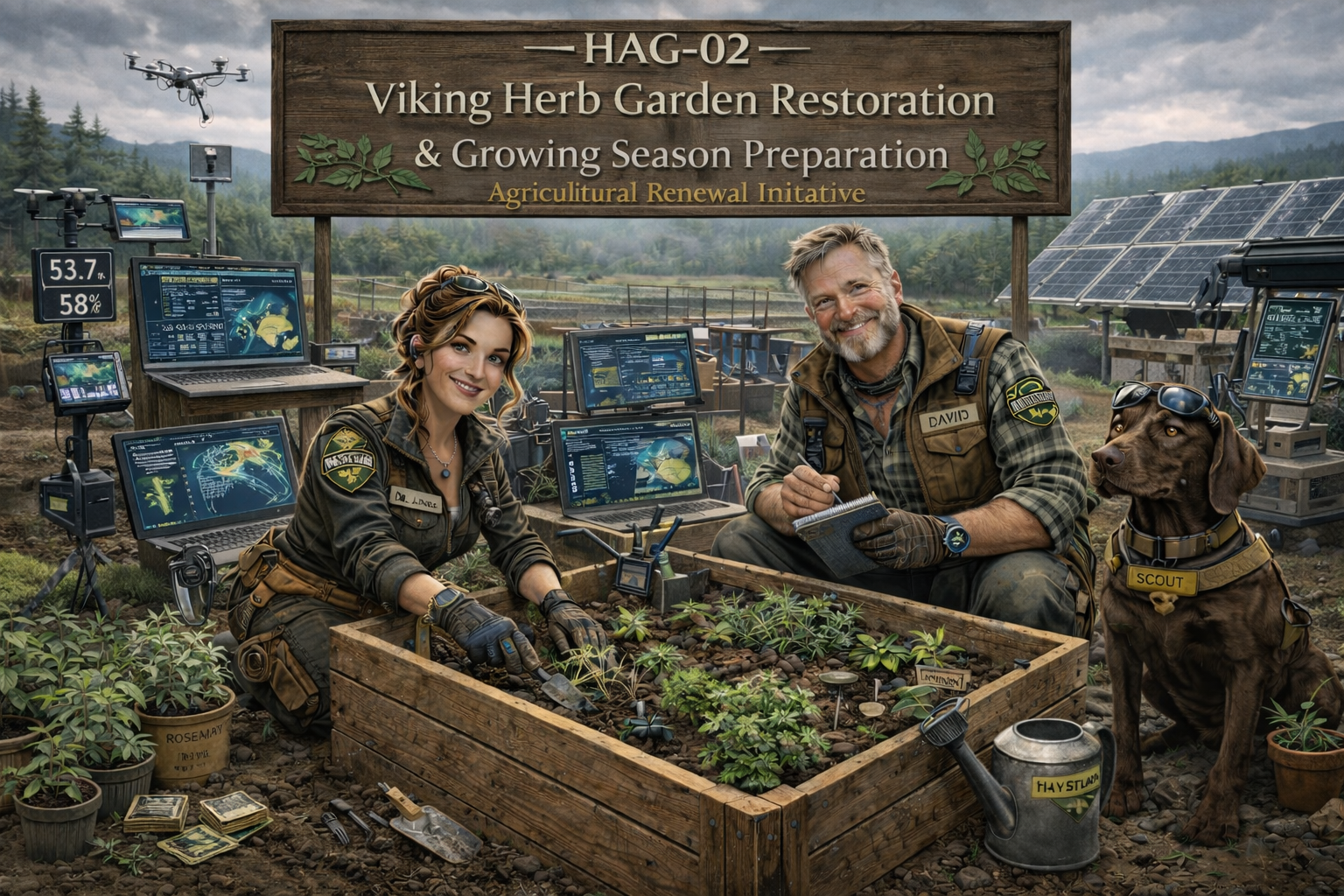
🌿 HAG-02 — Viking Herb Garden Restoration & Growing Season Preparation
Agricultural Renewal Initiative — April Deployment Window
FIELD CLASSIFICATION: Agricultural Systems • Botanical Research • Sustainable Cultivation
Prepared for Operational Deployment — Haystead Expedition Initiative
🌱 Project Overview
The Viking Herb Garden Restoration Project prepares the Haystead Viking Garden for the upcoming growing season through structural repair, environmental improvement, and agricultural planning.
Originally designed as a functional and historically inspired cultivation space, the garden now requires significant rebuilding following seasonal wear and environmental exposure. Raised beds have deteriorated beyond routine maintenance, fencing requires reinforcement, and access infrastructure including the garden gate must be repaired to restore protection from wildlife intrusion.
The April operational window focuses on rebuilding core infrastructure while establishing a planting strategy supporting culinary use, pollinator support, greenhouse experimentation, and biological research integration across Haystead operations.
🔬 Research & Development Goals
Rebuild and reinforce raised herb beds for long-term durability.
Improve soil health and drainage conditions.
Install ground cover to suppress weeds and reduce maintenance.
Restore fencing integrity to prevent animal intrusion.
Repair or replace garden access gate.
Develop seasonal planting plan aligned with Haystead agricultural objectives.
Support pollinator habitat expansion benefiting ranch ecosystems.
⭐ Why It Matters
Herb cultivation provides more than culinary benefit at Haystead.
Medicinal herbs, pollinator attractants, and companion planting species support greenhouse production, soil health, and biological research initiatives. A functioning herb garden also provides environmental observation opportunities supporting weather intelligence data correlation and seasonal trend tracking.
Restoring the Viking Garden ensures agricultural resilience while preserving a distinctive cultural feature of the ranch landscape.
🚧 Launch / Operational Plan
Phase I — Structural Restoration
Remove deteriorated raised bed materials.
Construct new reinforced bed frames.
Improve soil retention and drainage layers.
Repair fencing posts and reinforce perimeter protection.
Repair or replace garden gate hardware.
Phase II — Ground Preparation
Install weed barrier ground cover.
Lay gravel or mulch pathways where required.
Amend soil using compost and organic material.
Evaluate irrigation routing if required.
Phase III — Agricultural Planning & Planting
Develop herb planting map.
Select cold-hardy early season species.
Integrate pollinator-friendly varieties.
Establish labeling and growth tracking system.
🌾 Recommended Viking Garden Planting Focus (Optional Planning)
Potential categories include:
Culinary Herbs — thyme, sage, dill, parsley.
Medicinal Herbs — chamomile, yarrow, calendula.
Pollinator Support — lavender, bee balm.
Bio-Dome Companion Plants — basil and pest-deterrent species.
🤝 Support & Participation Opportunities
Soil amendment experimentation.
Historical planting research.
Pollinator monitoring integration.
Weather station correlation studies.
🎯 Mission Objective
To restore and prepare the Haystead Viking Herb Garden as a durable and productive agricultural system supporting culinary use, biological research initiatives, pollinator health, and sustainable seasonal cultivation at the Haystead Research Ranch.
Started Running January 1 2026
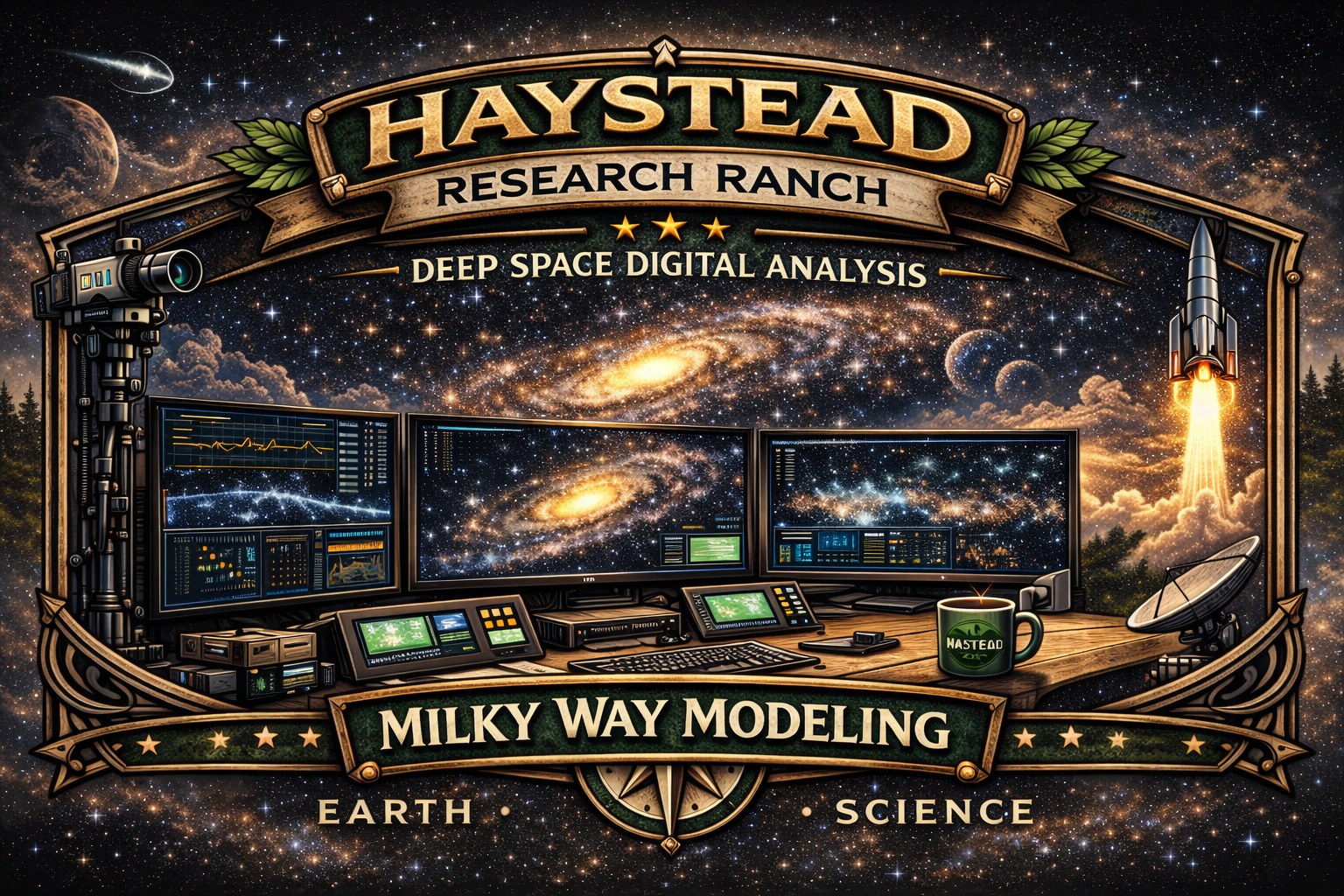
🌌 HAE-05 — Computational Astrophysics Participation Program
Milky Way Modeling Initiative — Operational Start January 2
FIELD CLASSIFICATION: Astrophysics • Distributed Computing • Scientific Data Analysis
Prepared for Operational Deployment — Haystead Expedition Initiative
🌱 Project Overview
Beginning January 2nd, computing systems within the Haystead Environmental Intelligence Center were formally assigned to participate in distributed scientific computation supporting the MilkyWay Modeling Project.
The initiative contributes processing power toward the creation of a highly accurate three-dimensional structural model of the Milky Way galaxy using observational data collected through the Sloan Digital Sky Survey.
Operating during available system idle time, Haystead computing resources assist in analyzing stellar streams, galactic structure formation, and gravitational interactions shaping the evolution of the galaxy.
Participation expands Haystead research activity beyond terrestrial observation, extending operational capability into astrophysical science through collaborative computational contribution.
🔬 Research & Development Goals
Contribute distributed processing capability to Milky Way structural modeling.
Maintain stable computational uptime through Environmental Intelligence Center infrastructure.
Monitor thermal performance and energy efficiency under sustained load.
Record operational contribution metrics and system performance.
Integrate astrophysics participation into Haystead expedition documentation programs.
⭐ Why It Matters
Large-scale astrophysical modeling requires immense computational resources beyond the capacity of single research institutions.
Distributed computing initiatives allow independent participants to contribute meaningful analysis toward scientific discovery.
Through participation, Haystead becomes part of an international scientific collaboration advancing understanding of galactic formation and stellar evolution.
The project aligns naturally with atmospheric observation and noctilucent cloud photography programs already conducted at the ranch, strengthening Haystead’s role as a multidisciplinary research environment.
🚧 Launch / Operational Plan
Phase I — System Preparation
Configure Environmental Intelligence Center computing nodes.
Install distributed computation software clients.
Verify secure network connectivity.
Phase II — Operational Monitoring
Track CPU and GPU thermal performance.
Monitor uptime and workload stability.
Evaluate power consumption under sustained processing.
Phase III — Documentation
Record contribution statistics.
Maintain operational logbook.
Integrate findings into Haystead expedition records.
🛰️ Scientific Collaboration
Primary Contribution:
MilkyWay Modeling Project
Objective:
Construct a precise 3D representation of the Milky Way galaxy.
Analyze stellar tidal streams.
Improve understanding of galactic evolution.
Data Source:
Sloan Digital Sky Survey observational datasets.
🤝 Support & Participation Opportunities
Hardware optimization experimentation.
Thermal efficiency analysis.
Website dashboard integration displaying contribution statistics.
Educational outreach documenting citizen science participation.
🎯 Mission Objective
To extend Haystead Environmental Intelligence Center capabilities into astrophysical research by contributing computational resources supporting the development of an accurate three-dimensional model of the Milky Way galaxy while promoting interdisciplinary scientific participation and long-term data stewardship.
July 2026
Pasture-Raised Flock Sustainability & Genetic Health Program
Launching: July
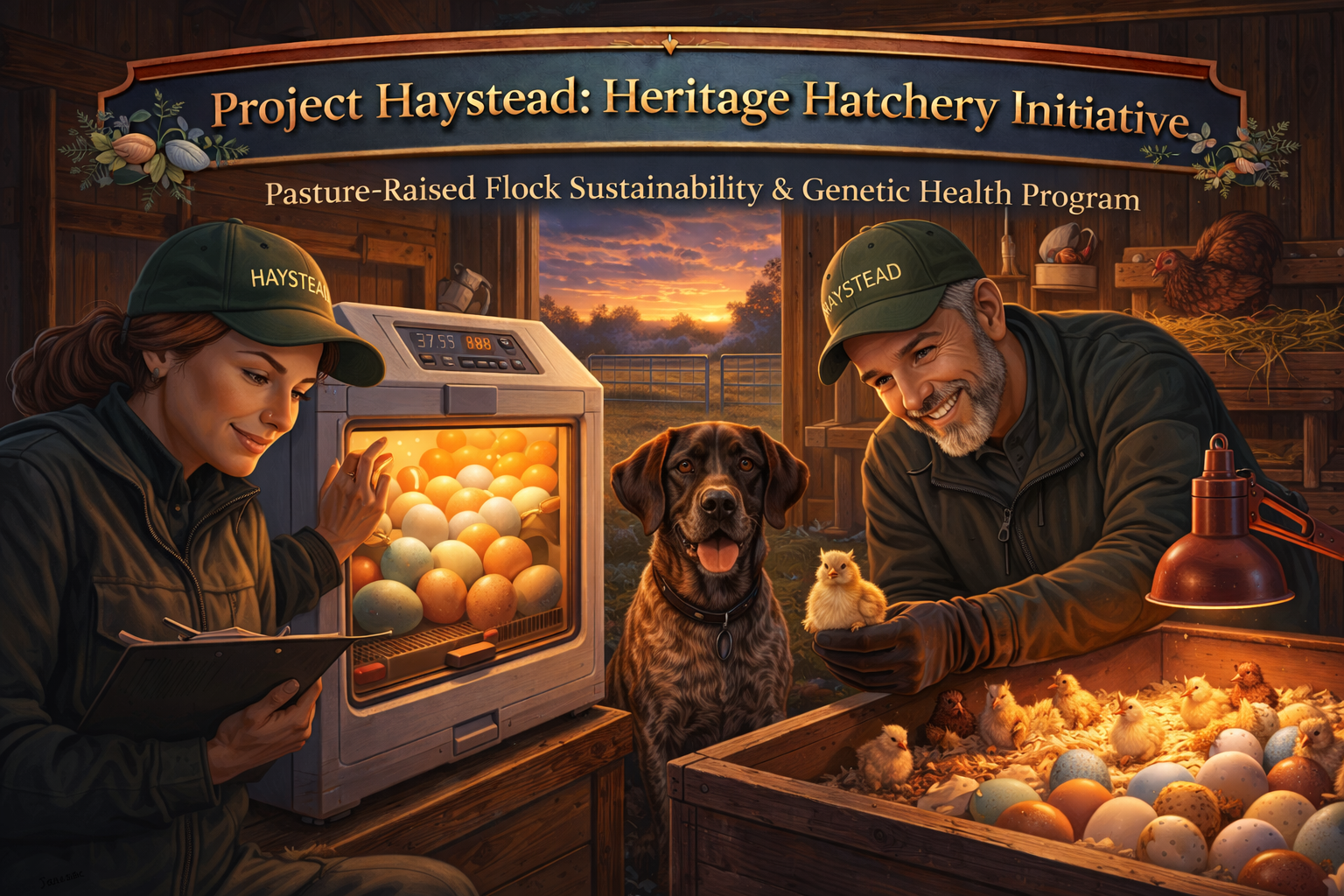
🐣 Project Haystead: Heritage Hatchery Initiative
🔬 Project Overview
The Haystead Heritage Hatchery Initiative is in its sixth year and focuses on maintaining a strong, self-sustaining flock through controlled incubation and natural reintegration practices.
Eggs gathered from Haystead’s free-range hens — representing multiple breeds and naturally diverse shell colors — will be incubated and hatched on-site. Chicks will be carefully raised and reintroduced into the established pasture flock to maintain population stability, strengthen genetic diversity, and support long-term food independence.
The project emphasizes:
Multi-species heritage and mixed-breed resilience
Pasture-based living conditions
Natural flock integration
Food-grade egg production standards
Ethical animal stewardship
Rather than relying on outside hatcheries, Haystead develops its own next generation of laying hens directly from proven pasture-adapted birds.
🌿 Research & Development Goals
1️⃣ Flock Sustainability
Maintain consistent flock numbers through internal breeding and hatching rather than outside sourcing.
2️⃣ Genetic Diversity & Health
Encourage hybrid vigor through multi-breed egg selection to produce hardy, disease-resistant birds adapted to Virginia conditions.
3️⃣ Pasture Adaptation
Raise birds specifically suited to rotational pasture environments and predator awareness.
4️⃣ Egg Production Quality
Develop nutrient-dense, food-grade egg layers capable of long-term sustainable production.
5️⃣ Ethical Animal Stewardship
Promote humane handling, natural behaviors, and low-stress flock integration practices.
🌎 Why It Matters
Modern commercial poultry systems prioritize rapid growth and uniformity, often sacrificing resilience and long-term health.
Haystead takes a different approach.
Healthy soil supports healthy plants.
Healthy plants support healthy animals.
Healthy animals support healthy families.
By hatching birds raised entirely within the Haystead ecosystem, the flock becomes better adapted to local climate, forage conditions, and pasture life.
This approach reduces dependency on external hatcheries while strengthening food security and animal welfare.
🚀 Launch Plan (July Activation)
Prepare and calibrate incubators
Select eggs from proven pasture-performing hens
Begin staggered incubation cycles
Monitor temperature, humidity, and hatch success rates
Raise chicks in protected brooder environments
Gradually integrate juvenile birds into pasture flock
🎯 Mission Objective
Develop a resilient, pasture-adapted laying flock capable of producing healthy, nutrient-dense eggs while maintaining ethical animal stewardship and long-term food independence.
Early June 2026
Black Soldier Fly Protein Recycling & Sustainable Feed Program
🪰 Project Haystead: BIO-POD Initiative
Black Soldier Fly Protein Recycling & Sustainable Feed Program
Launch: April
🔬 Project Overview
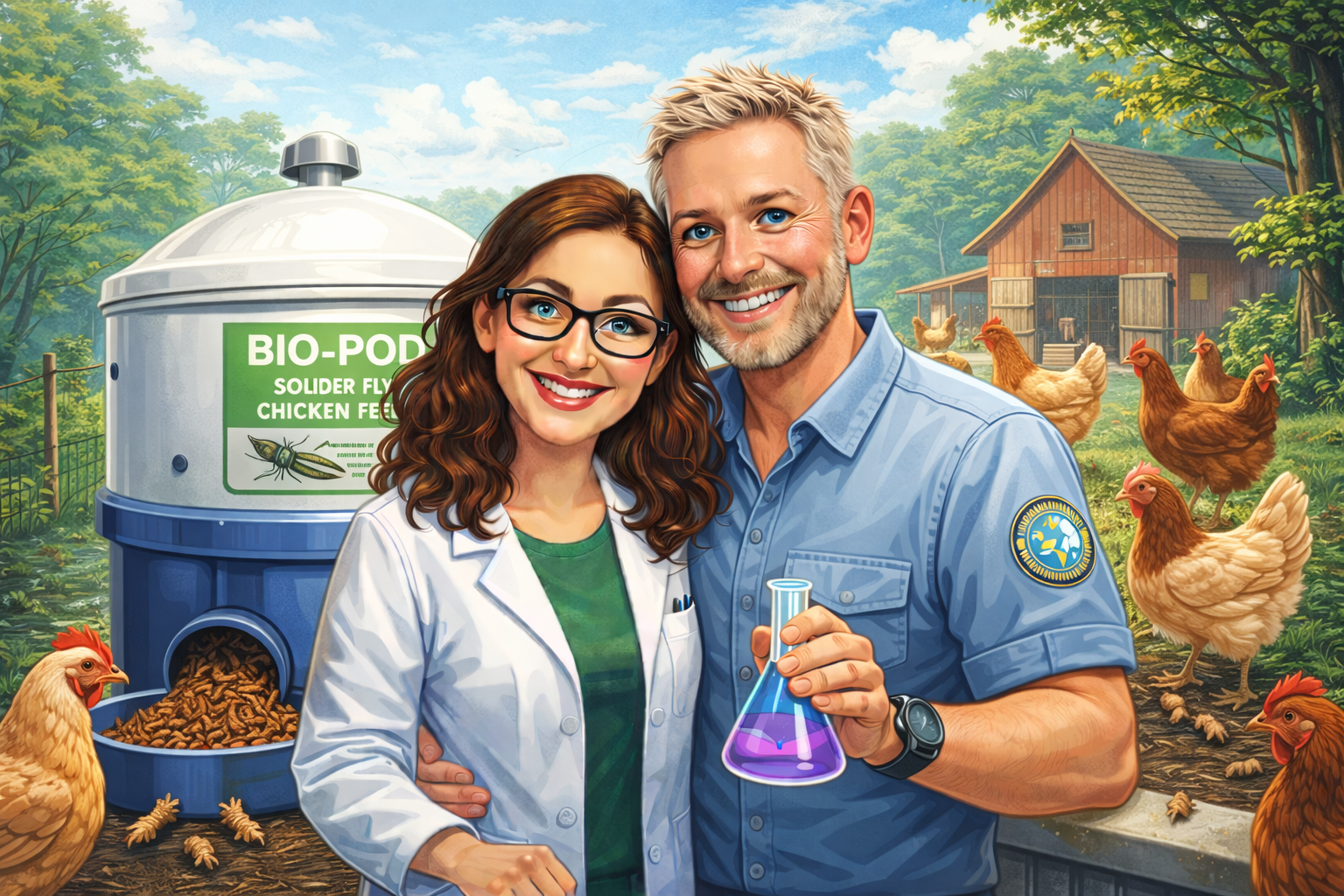
The Haystead BIO-POD Initiative establishes a closed-loop biological recycling system using Black Soldier Fly larvae to convert organic waste into high-protein livestock feed.
Beginning this April, Haystead will construct and deploy a dedicated soldier fly pod designed to naturally attract and cultivate Black Soldier Fly colonies. Organic kitchen scraps, garden waste, and compostable material will be transformed into nutrient-dense larvae — providing a sustainable, self-renewing protein source for pasture-raised poultry.
As larvae mature, they instinctively migrate from the pod into a collection chute, allowing automated harvesting directly into chicken feeding areas.
The system reduces waste while strengthening food independence through natural biological processes.
🌿 Research & Development Goals
1️⃣ Closed-Loop Waste Recycling
Convert organic food scraps and agricultural byproducts into usable feed rather than landfill waste.
2️⃣ Sustainable Protein Production
Provide a renewable, natural protein supplement for Haystead poultry flocks without reliance on commercial feed sources.
3️⃣ Soil Improvement
Capture remaining compost residue as a biologically active soil amendment for gardens and pasture systems.
4️⃣ Pest Reduction
Encourage beneficial Black Soldier Fly populations which naturally suppress nuisance housefly breeding.
5️⃣ Animal Health Optimization
Improve flock nutrition through diverse natural feeding behavior aligned with poultry instincts.
🌎 Why It Matters
Modern agriculture often separates waste disposal from food production.
Nature does not.
In natural ecosystems, decomposition feeds the next generation of life.
Black Soldier Fly larvae are extraordinary biological recyclers capable of converting large volumes of organic waste into usable biomass while producing minimal odor.
Benefits include:
Reduced feed costs
Reduced landfill contribution
Increased flock health
Soil nutrient cycling.
The BIO-POD Initiative strengthens Haystead’s goal of sustainable independence through ecological design.
🚀 Launch Plan (Weekend Deployment)
Construct BIO-POD structure and install drainage base
Select shaded installation location near poultry areas
Begin organic material loading cycle
Establish water management and ventilation control
Monitor initial colonization and larval activity.
🛠️ BIO-POD Construction Guide
Materials Needed
Large plastic tote or barrel (20–55 gallon recommended)
Lid (weather resistant)
PVC pipe or wooden ramp material
Collection container or bucket
Drill with hole saw
Hardware cloth or mesh screen
Gravel or drainage stone
Wood blocks or bricks (for elevation).
Step 1 — Container Preparation
Drill ventilation holes along upper sides of the container and cover openings with mesh to prevent predators while allowing airflow.
Add drainage holes to the bottom to prevent liquid buildup.
Step 2 — Install Drainage Layer
Add 3–5 inches of gravel or coarse material to the bottom.
This prevents anaerobic conditions and odor.
Step 3 — Create Self-Harvest Ramp
Install angled ramps inside the container using PVC or wood.
Mature larvae naturally climb upward seeking dry ground before pupation.
The ramp should lead toward an exit hole positioned near the lid.
Step 4 — Install Collection Chute
Attach tubing or a small chute from the exit hole leading into a collection bucket outside the pod.
Larvae will drop directly into the container — ready for feeding.
Step 5 — Placement
Install BIO-POD in:
Partial shade
Warm location
Near chicken run or compost area.
Avoid direct afternoon sun overheating.
Step 6 — Starting the Colony
Add:
Vegetable scraps
Fruit waste
Coffee grounds
Garden trimmings.
Avoid excessive oils or meats during startup.
Local soldier flies will colonize naturally.
🎯 Mission Objective
Convert waste into sustainable protein while strengthening flock health and advancing Haystead’s closed-loop ecological food systems.
Open 2026
🌦️HEX-05 — Haystead Environmental Intelligence Center (E.I.C.)
Integrated Data Operations Initiative — Fall Deployment Window
FIELD CLASSIFICATION: Expedition Support • Environmental Data Science • Systems Integration
Prepared for Operational Deployment — Haystead Expedition Initiative
🌱 Project Overview
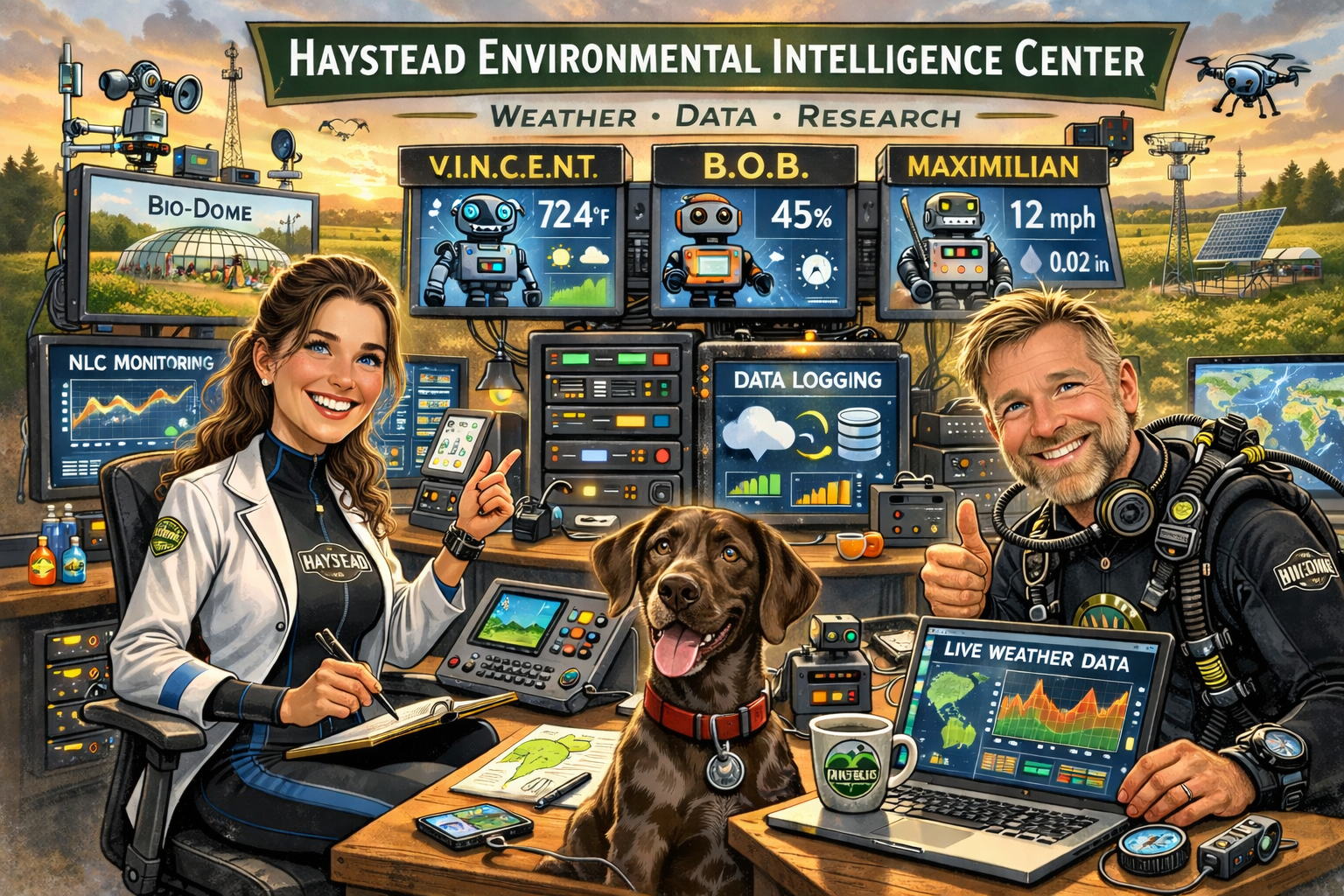
The Haystead Environmental Intelligence Center (E.I.C.) establishes a centralized monitoring and data recording hub designed to unify environmental, agricultural, atmospheric, and expedition systems operating across the Haystead Research Ranch.
As Haystead projects expand — including greenhouse cultivation, atmospheric observation, rocketry operations, biological systems research, and multi-station weather monitoring — the need for coordinated data collection and analysis becomes essential.
The E.I.C. serves as the operational brain of the ranch, receiving incoming environmental data streams from existing V.I.N.C.E.N.T., B.O.B., and Maximilian weather stations while supporting future sensor integration across the Bio-Dome, Bio-Pod, rocket range, and expedition readiness programs.
The system enables both real-time operational awareness and long-term scientific record keeping.
🔬 Research & Development Goals
Centralize environmental data from all Haystead monitoring systems.
Record long-term datasets supporting agricultural and atmospheric research.
Provide real-time dashboards accessible locally and through the website.
Support automated alerts for weather or environmental thresholds.
Enable cross-project data comparison and historical trend analysis.
Develop scalable infrastructure supporting future sensor expansion.
⭐ Why It Matters
Many Haystead initiatives rely directly on environmental conditions.
Greenhouse performance depends on temperature stability. Rocket launches require wind awareness. Atmospheric photography benefits from humidity and sky transparency monitoring. Biological research responds to seasonal change.
Without centralized recording, valuable observational data becomes fragmented or lost.
The Environmental Intelligence Center transforms individual instruments into a coordinated research ecosystem capable of documenting environmental change across years of experimentation.
This capability strengthens scientific reliability while supporting informed operational decision making.
🚧 Launch / Operational Plan
Phase I — Infrastructure Setup
Establish dedicated workstation or small server rack.
Install uninterrupted power supply tied to solar battery backup.
Configure wired or wireless network connections across ranch systems.
Phase II — Data Integration
Connect V.I.N.C.E.N.T., B.O.B., and Maximilian weather stations.
Integrate greenhouse climate sensors.
Prepare rocket range weather and telemetry feeds.
Enable Bio-Pod environmental monitoring integration.
Phase III — Website Publishing
Push live weather and environmental dashboards to Haystead website.
Enable historical graph viewing capability.
Automate daily data archiving.
Phase IV — Expansion Capability
Camera monitoring support for NLC observations.
Automated greenhouse alerts.
Expedition planning environmental forecasting tools.
🛰️ Core Monitoring Systems Integration
Weather Intelligence Network
V.I.N.C.E.N.T. — Primary Atmospheric Observer.
B.O.B. — Agricultural Microclimate Monitor.
Maximilian — Expedition Weather Sentinel.
Agricultural Systems
Bio-Dome greenhouse environmental monitoring.
Soil and irrigation reference data.
Atmospheric Programs
Rocket launch weather evaluation.
Noctilucent Cloud observation logging.
Biological Research
Bio-Pod lifecycle environmental tracking.
🤝 Support & Participation Opportunities
Website dashboard programming.
Data visualization development.
Sensor calibration and validation.
Network infrastructure planning.
Historical climate analysis projects.
🎯 Mission Objective
To establish a centralized environmental monitoring and data intelligence capability at the Haystead Research Ranch that records, analyzes, and distributes environmental information supporting agricultural research, atmospheric observation, expedition safety, and long-term scientific experimentation.

Summer 2026
🚀 HAE-03 — Haystead Experimental Rocketry & Atmospheric Sounding Program
Instrumented Flight Systems Initiative — August Operational Window
FIELD CLASSIFICATION: Atmospheric Observation • Experimental Engineering • Remote Instrumentation
Prepared for Operational Deployment — Haystead Expedition Initiative
🌱 PROJECT OVERVIEW
The Haystead Experimental Rocketry & Atmospheric Sounding Program establishes a controlled experimental flight range designed to support payload engineering, atmospheric sampling, and aerial documentation through repeatable model rocket launches.
Initial operations focus on installation of a permanent launch pad and safety perimeter capable of supporting progressive flight testing. Phase-II development introduces instrumented payload capsules containing cameras and environmental sensors designed to collect air temperature and flight condition data during ascent and recovery.
Each mission will operate under standardized launch procedures and designated flight numbering, allowing data comparison across launches and long-term atmospheric observation.
The program bridges engineering experimentation with atmospheric science while supporting Haystead’s broader expedition readiness initiatives.
🔬 RESEARCH & DEVELOPMENT GOALS
Construct a permanent adjustable rocket launch pad and safe recovery zone.
Develop modular payload capsules interchangeable between rockets.
Deploy onboard cameras capturing ascent and descent footage.
Collect atmospheric temperature data at altitude.
Experiment with telemetry transmission and recovery beacon tracking.
Evaluate parachute deployment and landing reliability.
Establish standardized flight checklists and safety protocols.
⭐ WHY IT MATTERS
Atmospheric sounding rockets have historically provided critical scientific insight through rapid vertical sampling of environmental conditions.
Scaled experimental launches allow similar principles to be explored safely at the ranch level while developing engineering skills in payload protection, aerodynamics, electronics integration, and data recovery.
For Haystead operations, the range becomes a hybrid engineering laboratory and observational science platform capable of supporting future atmospheric research initiatives.
🚧 LAUNCH / OPERATIONAL PLAN
Phase I — Range Construction
Establish designated FAA-compliant launch safety area.
Install anchored launch rail system.
Construct portable ignition control station.
Define recovery search perimeter.
Phase II — Instrumentation Development
Build modular payload capsules.
Integrate temperature and environmental sensors.
Install onboard camera systems.
Test data logging and retrieval.
Phase III — Operational Flights
Progressive altitude testing.
Flight documentation and video capture.
Data comparison between launches.
Recovery reliability validation.
🛰️ HAYSTEAD FLIGHT DESIGNATION SYSTEM
Each launch receives a mission identifier:
HR-01 — Initial Systems Validation
HR-02 — Camera Payload Test
HR-03 — Atmospheric Temperature Sampling
Flight logs include:
Weather conditions
Motor class
Maximum altitude
Recovery distance
Payload performance
🤝 SUPPORT & PARTICIPATION OPPORTUNITIES
Payload electronics programming.
Telemetry monitoring station operation.
Environmental data analysis.
Flight photography and recovery tracking.
STEM outreach demonstrations.
🎯 MISSION OBJECTIVE
To establish a safe experimental sounding rocket capability at the Haystead Research Ranch enabling atmospheric observation, payload engineering development, and mission-based scientific experimentation through instrumented flight operations.
Summer 2027
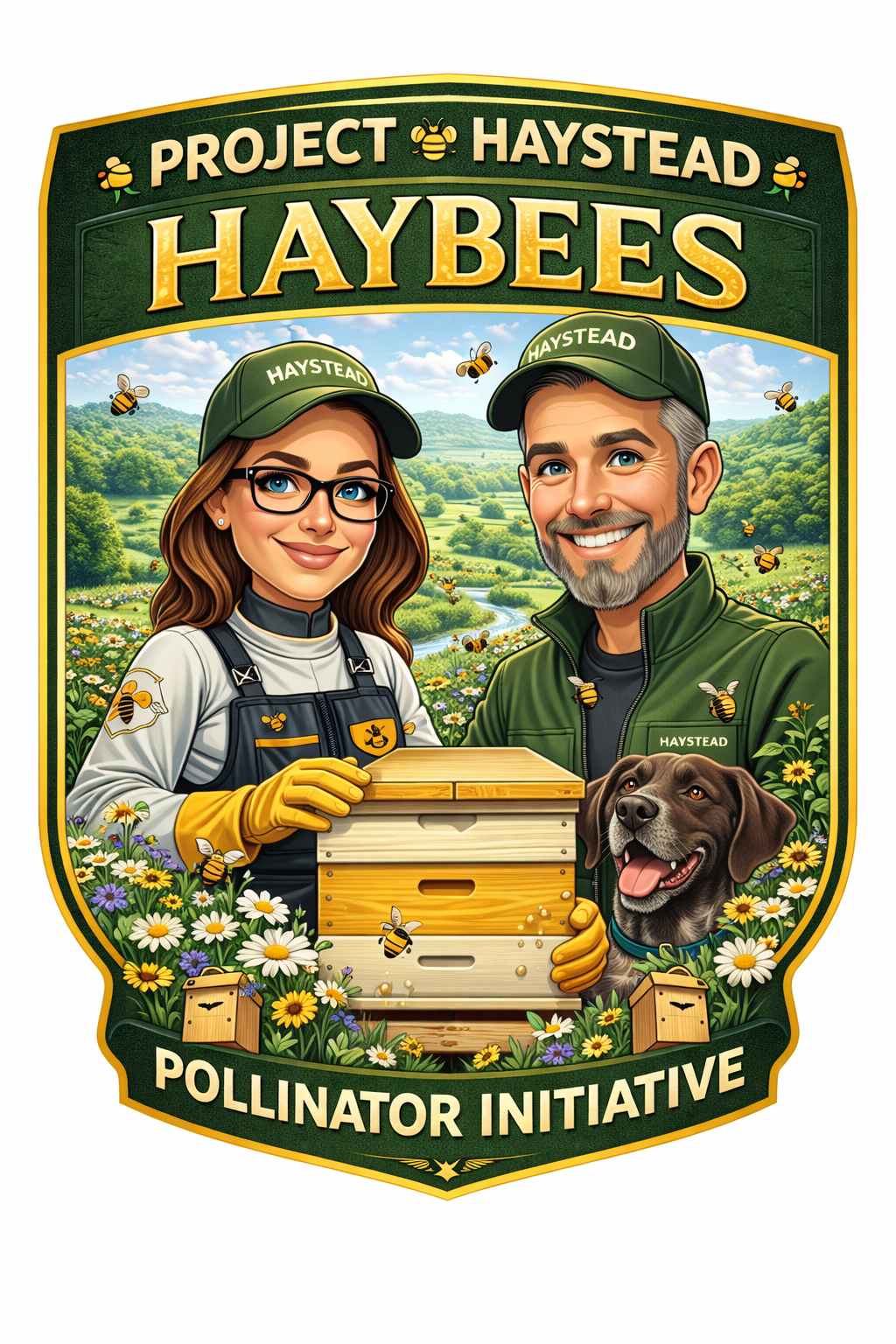
🐝 Project Haystead: HAYBEES Initiative
Pollinator Habitat & Honey Bee Restoration Project
Launch: This Summer
🔬 Project Overview
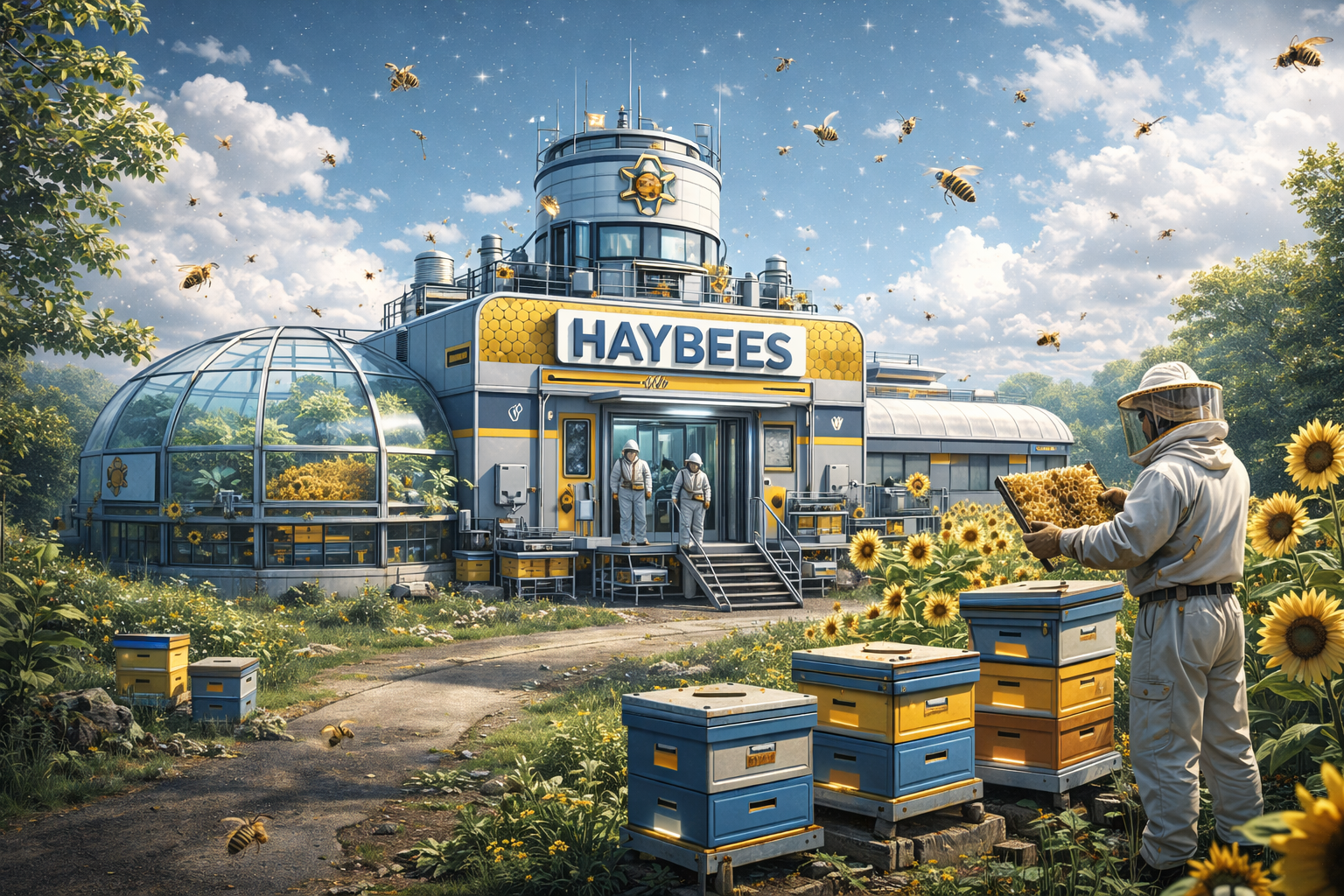
The Haystead HAYBEES Project establishes a dedicated honey bee habitat designed to support pollination across the biodome greenhouse and surrounding Haystead agricultural systems while contributing to regional pollinator recovery.
Located within a natural mini-valley on the Haystead property, this project will feature:
Multiple managed bee hives
Expanding wildflower habitat left intentionally natural
Clean freshwater drinking stations for hive health
Pollination support for greenhouse and field crops
Long-term bee population monitoring
The valley is being allowed to return to a wildflower-dominant state to create a continuous seasonal nectar corridor — working with nature rather than against it.
🌿 Research & Development Goals
1️⃣ Pollinator Support & Biodiversity
Establish healthy honey bee colonies to improve pollination rates throughout the Haystead ecosystem.
2️⃣ Greenhouse Integration
Enhance productivity and plant health through improved pollination within the biodome and surrounding gardens.
3️⃣ Habitat Restoration
Encourage native flowering species and create long-term forage stability through natural meadow development.
4️⃣ Hive Health Monitoring
Track colony strength, seasonal activity, and environmental influences on hive performance.
5️⃣ Community Conservation Participation
Invite community support through hive, equipment, and material donations to help expand pollinator infrastructure.
🌎 Why It Matters
Pollinator populations are declining across the world, threatening food production and ecosystem stability.
Honey bees play a critical role in:
Food crop pollination
Wild plant reproduction
Biodiversity maintenance
Ecosystem resilience
By creating a protected, well-supported habitat, the HAYBEES Project contributes to:
Local pollinator recovery
Sustainable food production
Healthier greenhouse and agricultural systems
Community awareness and education
Simply put:
We need bees.
🚀 Launch Plan (Summer Activation)
Establish initial hive locations in the mini-valley
Introduce flowering plant succession zones
Install multiple clean drinking water stations
Acquire and place starter hives
Begin baseline hive health and activity monitoring
Integrate pollination tracking with greenhouse data
🤝 Community Support & Donations
The HAYBEES Project is community-supported.
We are actively seeking donations and sponsorship for:
Complete bee hives
Frames and hive boxes
Protective equipment
Feeders and tools
Beekeeping supplies and maintenance equipment
Supporters help expand pollinator habitat and directly contribute to ecological restoration at Haystead.
🎯 Mission Objective
Restore and support healthy pollinator populations while integrating honey bee ecology into the Haystead closed-loop food and habitat system.
Updates :
Spring 2026 we started a massive wildflower planting initiative to support our new Hay-Bees residence.
Summer 2026
🚤 HEX-06 — R/V Green Hornet Seasonal Refit & Expedition Readiness
Inland Research Vessel Operations — Mid-May Deployment Window
FIELD CLASSIFICATION: Expedition Support • Aquatic Research • Environmental Observation
Prepared for Operational Deployment — Haystead Expedition Initiative
🌱 Project Overview
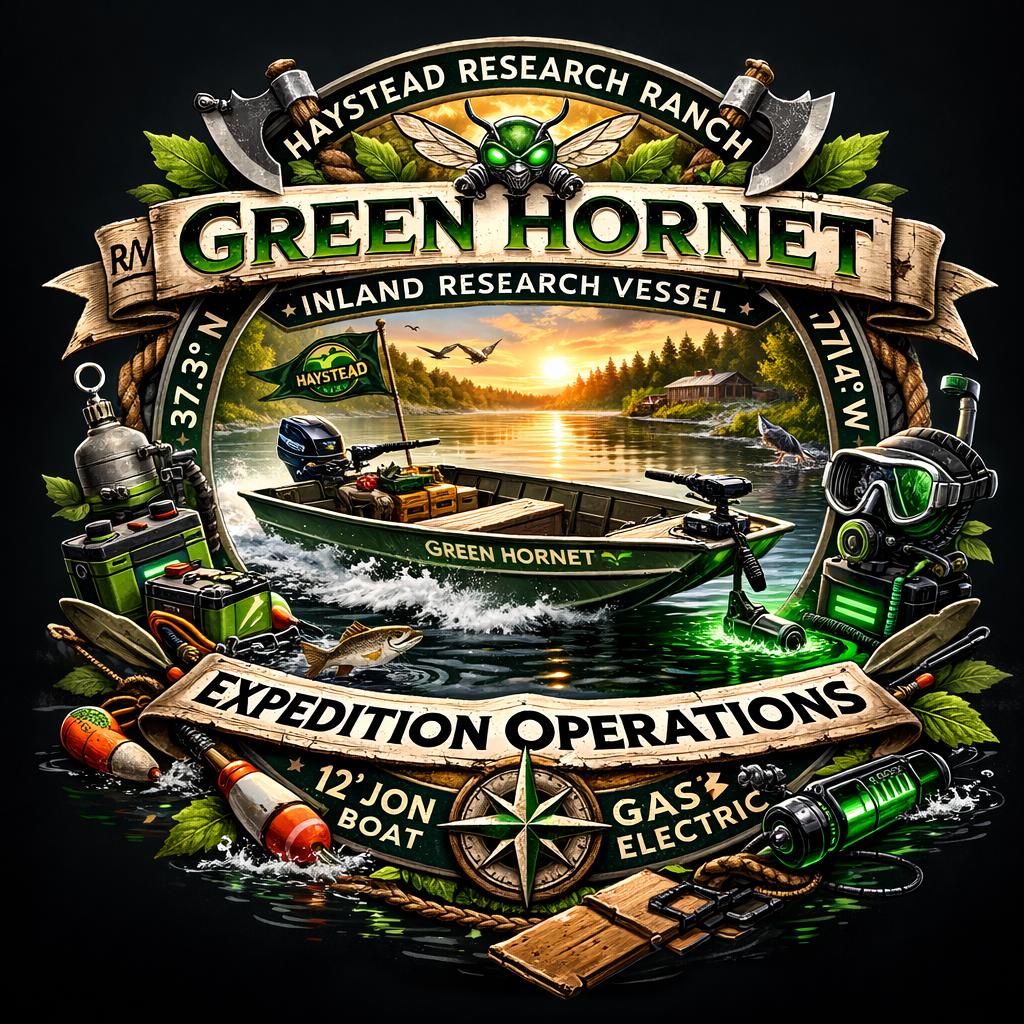
The R/V Green Hornet serves as the primary small-water research platform supporting Haystead aquatic observation, environmental monitoring, and expedition fieldwork across area lakes and the James River.
The vessel’s shallow draft and dual propulsion configuration — gas outboard and electric trolling motor — allow quiet operation in sensitive ecological areas while maintaining range capability for extended exploration.
Following winter storage, the vessel requires seasonal refit and operational preparation to ensure safety, reliability, and mission readiness for the upcoming research season.
Mid-May operations focus on structural inspection, propulsion maintenance, equipment organization, and installation of modular research capability supporting data collection and scientific diving operations.
🔬 Research & Development Goals
Restore vessel safety and operational reliability.
Service gas and electric propulsion systems.
Improve onboard equipment organization.
Establish modular mounting capability for research instruments.
Support environmental observation and aquatic sampling missions.
Prepare vessel for diver support and recovery operations.
Develop expedition-ready safety and communication procedures.
⭐ Why It Matters
Access to waterways dramatically expands Haystead research capability.
Lakes and river systems provide opportunities for environmental observation, aquatic biological study, atmospheric photography positioning, and equipment testing inaccessible from land.
A properly prepared vessel ensures safe deployment while supporting rapid-response field operations throughout the growing and observation seasons.
The Green Hornet functions not simply as a recreational craft but as a mobile research extension of the Haystead Environmental Intelligence Network.
🚧 Launch / Operational Plan
Phase I — Structural Inspection
Hull inspection for damage or corrosion.
Verify trailer condition and lighting.
Inspect flotation and drainage systems.
Phase II — Propulsion Maintenance
Service gas outboard motor.
Replace fuel lines if required.
Inspect trolling motor wiring and batteries.
Test charging systems.
Phase III — Research Refit
Install equipment storage solutions.
Prepare mounting points for cameras or sensors.
Establish dry storage for electronics and documentation.
Prepare diver support equipment staging.
Phase IV — Safety & Operational Readiness
Inspect life jackets and safety equipment.
Install communications capability.
Establish launch checklist procedures.
Conduct water trial verification.
🧪 Potential Research Applications
Aquatic ecosystem observation.
Riverbank photographic surveys.
Atmospheric photography positioning.
Environmental sampling.
Scientific diving support.
Sensor deployment testing.
🤝 Support & Participation Opportunities
Electronics mounting solutions.
Waterproof data logging systems.
Camera stabilization experimentation.
Expedition documentation photography.
🎯 Mission Objective
To prepare the R/V Green Hornet as a safe, reliable, and modular inland research vessel capable of supporting aquatic observation, environmental monitoring, and expedition field operations across regional waterways throughout the Haystead operational season.
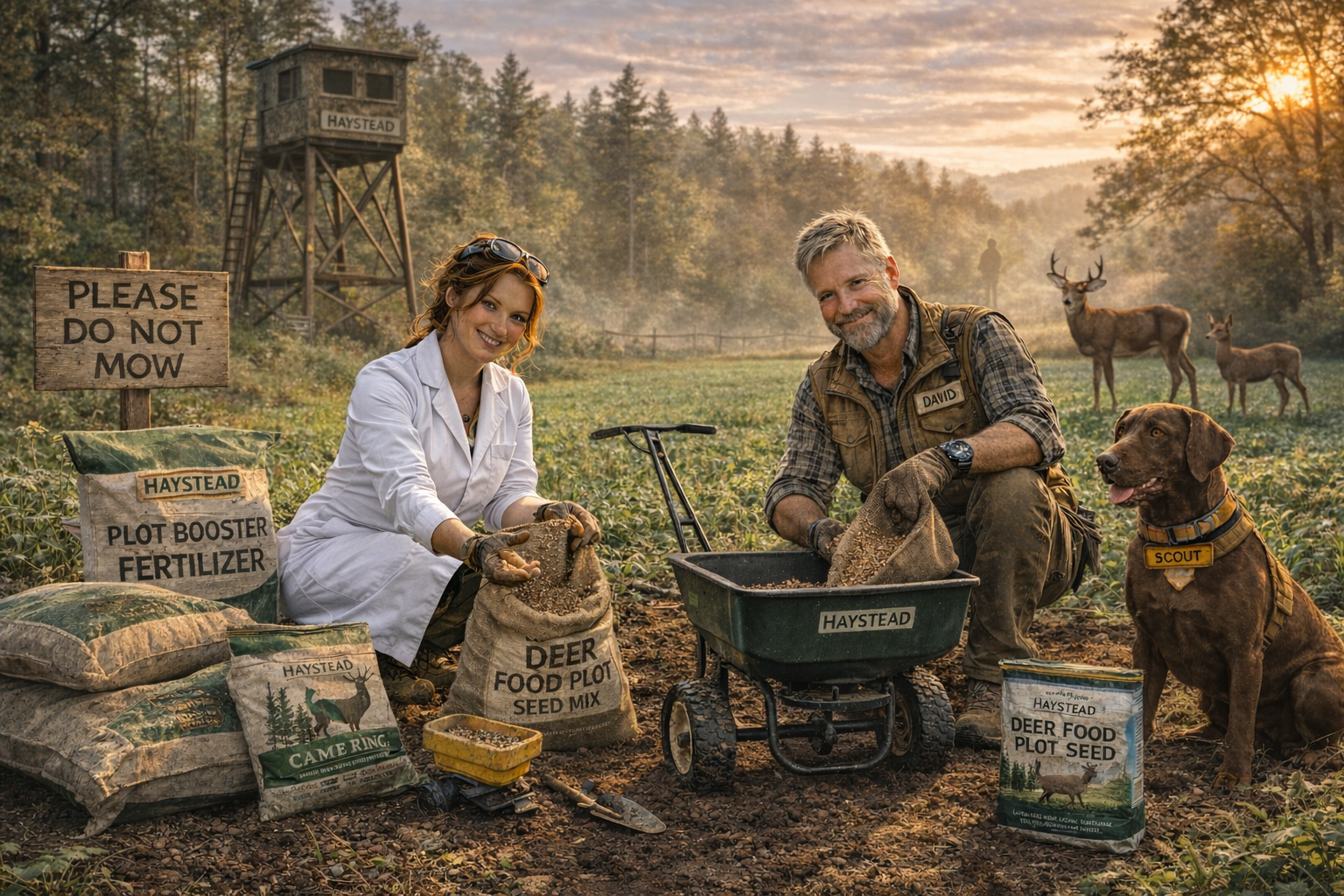
August 2026
🌾 HAG-04 — Deer Management Food Plot Initiative
Habitat Optimization & Wildlife Sustainability Program
Project Overview
HAG-04 — Deer Management Food Plot Initiative establishes three strategically positioned wildlife nutrition zones across Haystead Research Ranch. Two plots are located within managed woodland corridors, and one plot is positioned in the East Field sector. All three sites are supported by elevated tower stands for monitoring, observation, and population assessment.
Planting operations begin August 1st, marking the transition into late-summer habitat preparation and fall forage establishment.
This initiative integrates wildlife stewardship, land management science, and population health tracking into a structured, data-informed program.
Research & Development Goals
Establish three nutritionally balanced forage plots
Improve seasonal deer health and body condition
Reduce over-browsing pressure on sensitive habitat zones
Concentrate movement patterns for population monitoring
Support controlled herd management strategies
Integrate wildlife activity data into Haystead environmental reporting
Why It Matters
Healthy wildlife populations require intentional land management.
By installing structured food plots:
We improve forage quality during pre-rut and winter transition
We support antler development and overall herd vitality
We reduce stress on native browse species
We create predictable movement corridors for monitoring
We enhance ecological balance across woodland and field environments
This project also supports:
🌲 Forest regeneration management
🌾 Field sustainability planning
📊 Data-driven wildlife observation from tower stations
🛰️ Long-term environmental tracking efforts
Wildlife stewardship is ecosystem stewardship.
Launch / Operational Plan
Phase 1 — Site Preparation (July Final Week)
Soil testing at all three plot sites
Lime and nutrient amendment as required
Brush clearing and light tilling
Access path maintenance to tower stands
Phase 2 — Planting Activation (Beginning August 1st)
Woodland Plot A — Shade-tolerant forage mix
Woodland Plot B — Brassica and protein blend
East Field Plot — High-visibility cereal grain and clover mix
Seeding calibration and coverage verification
Phase 3 — Monitoring & Observation
Weekly growth assessment
Camera and stand-based population observation
Forage utilization rate tracking
Seasonal herd health documentation
Support & Participation Opportunities
Plot sponsorship (Woodland A, Woodland B, East Field)
Volunteer planting day
Wildlife observation log submissions
Youth conservation education sessions
Data collection collaboration with regional wildlife agencies
Mission Objective
To responsibly manage deer populations through strategic forage development, improve herd health, and maintain ecological balance while integrating structured monitoring from all three elevated tower stations.
This initiative reinforces Haystead’s commitment to:
Observation. Stewardship. Sustainability.
Build / Implementation Guide
Materials Required
Regional food plot seed blends
Soil test kits
Lime and fertilizer (as indicated by soil results)
Broadcast spreader or drill seeder
Trail cameras (optional but recommended)
Stand safety inspection equipment
Basic Installation Steps
Conduct soil test and correct pH (ideal range: 6.0–7.0 depending on species)
Clear competing vegetation
Prepare seed bed (light till or no-till method depending on soil condition)
Calibrate spreader for correct seed density
Broadcast seed evenly
Lightly drag or roll seed for proper soil contact
Document planting date and weather conditions
Install monitoring protocol
🌾 HAG-04 Status: Activation Scheduled
Planting Begins: August 1
Monitoring Platforms: Tower Stand A (Woodland North), Tower Stand B (Woodland South), Tower Stand C (East Field)

HAYSTEAD RANCH PROJECT WORKSHEET
HRR-2026-005-AGRI
Ranger Mobility Platform Refit — Ranger 1 & Ranger 2
🔬 Project Overview
Ranger 1 and Ranger 2 are Haystead Ranch’s all-terrain mobility platforms, designed to extend operational range beyond foot travel without reliance on fuel-based systems.
Following extended storage, both units have been moved into the Hay-Forge for a full refit, upgrade, and recommissioning.
These platforms support:
Field scouting
Perimeter checks
Expedition support (paired with RV Defiant)
Local rapid-response movement
🎯 Mission Objective
Restore, upgrade, and optimize Ranger 1 & Ranger 2 into fully operational, field-ready mobility systems capable of supporting daily ranch operations and extended scouting missions.
🛠️ Refit Scope
🔧 Mechanical Restoration
Replace tires (all-terrain rated)
Inspect/replace inner tubes
Service drivetrain (chain, cassette, crankset)
Adjust/replace braking systems
Bearing inspection (hubs, bottom bracket, headset)
💡 Systems Upgrades
Install upgraded front & rear lighting systems
Add reflective and visibility enhancements
Mount gear carriers / storage packs
Add onboard tool kits
🧼 Cleaning & Recovery
Full frame cleaning and inspection
Rust treatment / prevention
Lubrication of all moving parts
Fastener tightening and integrity check
🧪 Research & Development Goals
Evaluate non-motorized mobility efficiency on ranch terrain
Determine optimal gear loadout for scouting missions
Test durability of upgraded components
Develop rapid deployment capability for field operations
🚴 CORE MAINTENANCE WORKSHEET (FIELD + FORGE)
⚠️ Critical Wear Components
Replace as needed:
Brake pads
Chain (stretch/wear)
Tires (cracking or tread loss)
Tubes (frequent flats)
Cables (fraying/stiffness)
📦 Recommended Field Kit (On Each Ranger Unit)
Mini air pump
Patch kit + spare tube
Multi-tool (Allen + chain tool)
Tire levers
Small first aid kit
Flashlight / backup light
Water + basic supplies
🔄 Future Development
Evaluate adding:
Cargo trailers
Solar charging lighting systems
GPS tracking / route logging
Radio mounts for comms
🧭 Mission Status
Phase: Refit & Upgrade (Active)
Location: Hay-Forge
Units: Ranger 1 & Ranger 2
Status: 🟡 In Progress
Haystead Ranch is a completely independent project, and this site simply documents our journey as we share it. We make no claims, guarantees, or promises regarding the information presented.